Why AI Work Products Are Converging on MCP in 2026
What recent ChatGPT Apps, Claude Connectors, Gemini Enterprise, WorkBuddy, and Alibaba Cloud Model Studio updates reveal about MCP as a shared interface for enterprise data and tools.
The short answer
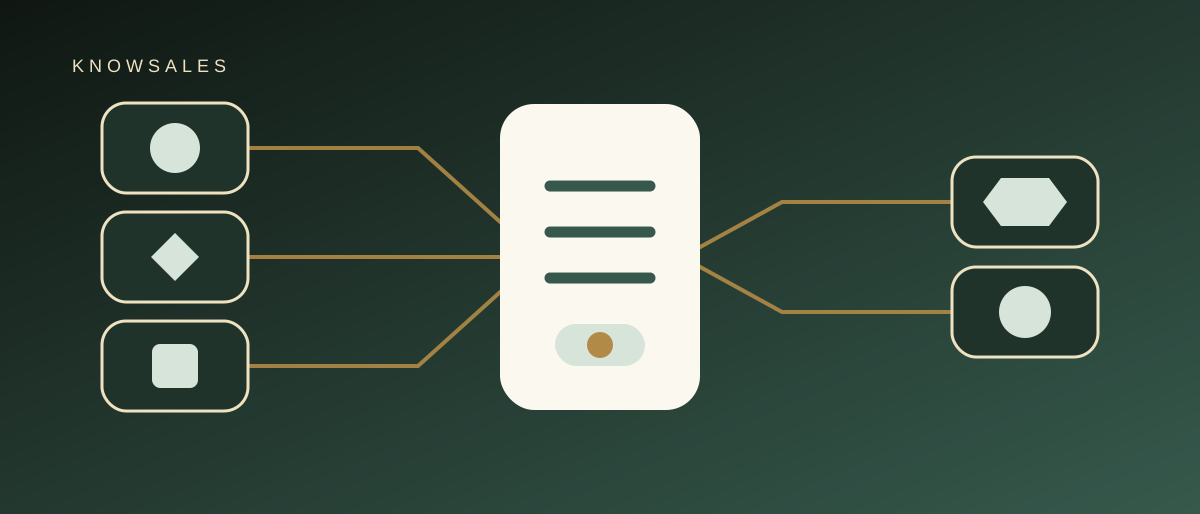
The important change in 2026 is not only that foundation models keep improving. AI work products are increasingly bringing enterprise data, external tools, and executable actions into the same work surface. Model Context Protocol (MCP) is becoming an important connection layer in that shift.
This does not mean every platform is fully interoperable, or that an MCP connection is automatically safe. A more accurate reading is:
- ChatGPT, Claude, and Gemini Enterprise are expanding connections to external data and tools;
- WorkBuddy and Alibaba Cloud Model Studio provide MCP configuration or hosting paths;
- permission, authentication, write confirmation, and admin control are becoming core product concerns;
- companies can maintain a durable business-context layer instead of copying all knowledge into every AI product.
For a sales organization, that durable layer should hold customer profiles, product knowledge, communication history, and reviewed industry experience. Models and workspaces may change. Account memory should not have to start over.
What the recent official updates actually show
The table below uses vendor documentation as evidence of product direction. Vendor statements are not independent proof of business outcomes.
| Platform | Recent official direction | Boundary that still matters |
|---|---|---|
| ChatGPT | OpenAI has consolidated connectors into its Apps/Plugins system and is testing full MCP with write and modify actions for eligible workspaces | Full write support remains subject to beta, plan, role, admin, and web-only conditions |
| Claude | Remote MCP connectors can reach external tools, while enterprise controls are adding centralized authorization, roles, and revocation | Cloud connectors, local MCP, Claude Code, and Cowork do not use one identical setup path |
| Gemini Enterprise | Admins can connect a custom MCP server so Gemini Enterprise can reach private data and tools | Google's help page labels the feature Pre-GA, so support and interfaces may change |
| WorkBuddy | Official documentation describes adding an MCP server with a URL, authentication details, and OAuth where supported | Product version, account environment, and server transport still require validation |
| Alibaba Cloud Model Studio | Model Studio supports script hosting, gateway and OpenAPI imports, and remote HTTP MCP for agents and workflows | Platform capability must not be generalized to every Qwen consumer experience |
Primary sources: OpenAI Developer Mode and MCP Apps, Plugins in ChatGPT and Codex, Claude enterprise-managed authorization, Gemini Enterprise custom MCP, WorkBuddy MCP guide, and Alibaba Cloud Model Studio custom MCP.
What “converging on MCP” does not mean
It does not mean every AI client is already interchangeable
Platforms may support different transports, authentication flows, OAuth scopes, and tool schemas. MCP support in a cloud platform does not prove that every consumer chat product from that company exposes the same connection path.
It does not authorize unrestricted writes
Reading product knowledge, creating an account, changing a follow-up date, and deleting data carry different risks. The protocol connects systems; the organization still defines least privilege, confirmation, audit, and revocation.
It does not make models understand company facts automatically
A tool can return data while the model still selects the wrong customer, date, or knowledge version. Entity checks, citations, and post-write readback remain necessary.
It does not force a company into one permanent AI workspace
Standardized connections can separate the model surface from business memory. One user may prefer ChatGPT for writing, Claude for files and research, or WorkBuddy and Qwen-based environments for other workflows without rebuilding the sales record each time.
A synthetic sales workflow
Imagine an equipment supplier responding to a new inquiry from “Company A.” The salesperson wants an AI agent to:
- determine whether Company A already has a record and avoid a duplicate;
- retrieve the last communication, confirmed application needs, and relevant product knowledge;
- draft a reply that separates known facts from specifications still awaiting engineering confirmation;
- save the sent communication and next step as a new activity.
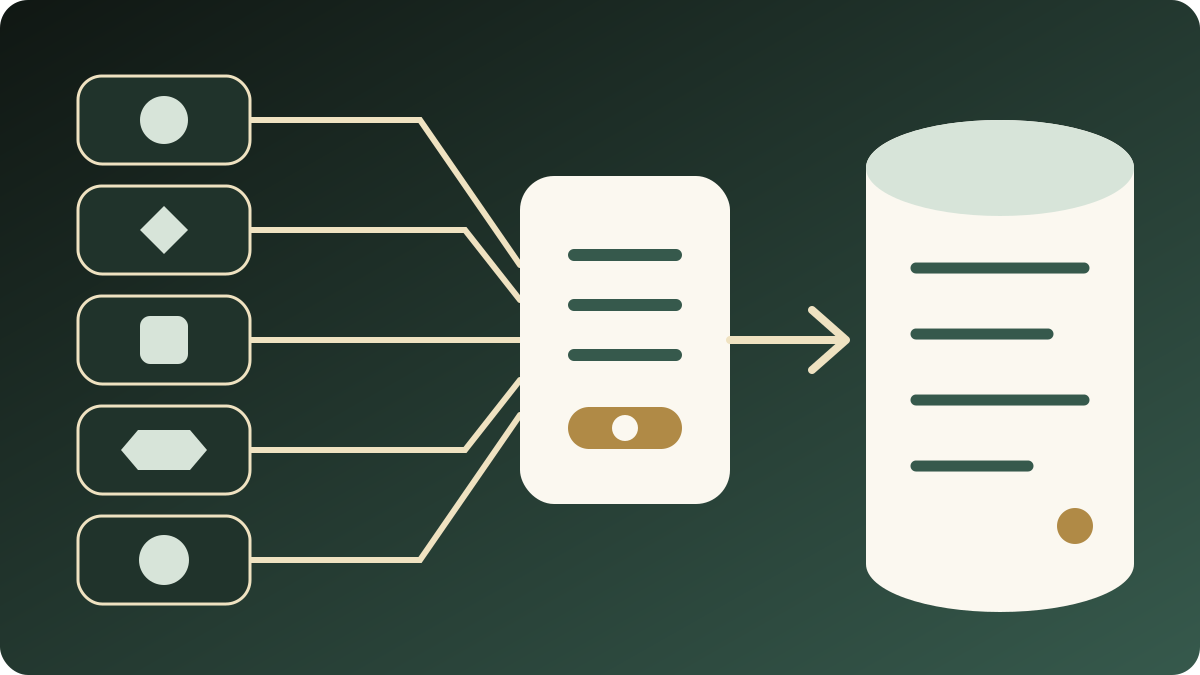
If all context lives in one AI conversation, changing workspaces means explaining the account again. If customer, product, and activity objects live in a durable context layer, an authorized AI agent can retrieve the same facts through explicit tools.
The decisive question is not only which model writes most naturally. It is whether the agent found the same Company A, used the current product source, and wrote the actual event to the correct record.
Why sales teams need a separate context layer
| Sales information | Rate of change | Appropriate system of record |
|---|---|---|
| Company background, contacts, industry, stable preferences | Slow | Customer profile |
| Emails, calls, meetings, commitments, and next steps | Event-based | Customer activity |
| Specifications, FAQs, applications, and process knowledge | Iterative | Product knowledge base |
| News and public company signals | Real time | External evidence layer; review before capture |
| AI drafts and reasoning | Temporary | Current task context, not a business fact |
This separation reduces two common errors: putting a one-time event into a durable customer profile, and writing a web inference as if the customer had confirmed it.
Where KnowSales fits
KnowSales is more accurately positioned as an MCP-native sales context and tool layer, not another general-purpose AI work product. It currently provides foundations to:
- organize customer profiles, activities, and product knowledge;
- let authorized AI agents retrieve task-specific context through tools;
- limit visibility through API keys, tool allowlists, workspace roles, and audiences;
- permit controlled writes where appropriate and verify the result through object readback;
- let salespeople and consultants remain in the AI workspace they already know.
As of August 28, 2026, a KnowSales user has continuously performed bidirectional workflows from Codex, Claude Code, Cowork, WorkBuddy, and the currently configured Qwen path. That is first-hand user evidence, not vendor certification.
ChatGPT full MCP write actions are moving through an official beta path, while Gemini Enterprise custom MCP remains Pre-GA. This article treats both as clear market direction, not as completed KnowSales end-to-end verification.
Six questions for evaluating an MCP work system
- What is connecting? A remote MCP server, a local desktop server, or a platform-hosted tool?
- How is identity carried? Personal OAuth, organization IdP, service account, or a dedicated API key?
- Which tools are visible? Does
tools/listexpose only the tools appropriate for the current role? - Which actions write data? Are read, suggest, create, modify, and delete separated?
- How is the result verified? Can the system read the object back by a stable ID instead of trusting an agent's “success” message?
- How is access revoked? Can one connection be removed quickly when a project ends, an employee leaves, or a client credential leaks?
Without answers to these questions, MCP proves connectivity, not production readiness.
Three implications for the 2026 AI work market
1. Model capability will change faster than business connections
Companies can change models. Customer identity, product versions, permission rules, and audit requirements remain.
2. Competition will move from answering to acting safely
Internal search is only the first step. Production sales workflows must handle wrong accounts, outdated knowledge, duplicate writes, and revoked access.
3. General agents will not automatically replace vertical context layers
General agents are strong at search, reasoning, documents, and tool orchestration. Vertical systems own business objects, field contracts, durable memory, and industry boundaries. The likely architecture is a combination, not a simple replacement.
Related reading
- What Is MCP? A Guide for Sales Teams
- Why the Sales AI Moat Is Not the Model
- KnowSales MCP in Practice
- AI Agent Governance for Sales Teams
Next step
If you want to keep using a familiar AI agent while customer records, product knowledge, and communication history remain durable, connect an AI workspace to KnowSales with least privilege. Validate the tool list, a read-only query, a controlled write, and readback before broader use.
Sources checked August 28, 2026. Vendor features, plans, regions, administrator settings, and preview status can change. Protocol support is not presented as KnowSales end-to-end compatibility.