Why the Sales AI Moat Is Not the Model: GPT-5.6, Claude Opus 5, and Gemini 3.7
A sales AI framework for connecting Codex, Claude Code, Cowork, WorkBuddy, Qwen, and other MCP clients to one durable sales context layer.
The short answer
Model quality matters, but the durable moat in sales AI is rarely a permanent attachment to the newest model. It is the system around the model:
- clean, continuous customer and product context;
- answers that trace back to evidence;
- permission, confirmation, audit, and revocation controls;
- sales memory that survives a model upgrade;
- task-based model choice instead of permanent vendor lock-in.
In practical terms, a sales professional should not need to learn another chat interface just to use company knowledge. They can remain in a familiar general-purpose AI agent while KnowSales supplies customer profiles, product knowledge, communication history, and permission-controlled tools behind the scenes.
That is the more precise role for KnowSales today: an MCP-native sales context and tool layer. Its built-in Agent is a complementary access and management surface, not a claim to replace the interaction quality of large general-purpose AI work products.
In 2026, models such as GPT-5.6, Claude Opus 5, and Gemini 3.7 Flash continue to advance reasoning, tool use, and efficiency. For a sales team, the right question is not “which model will always be best?” It is “which model fits this task without taking our business memory hostage?”
Why model leaderboards do not answer sales selection
Public benchmarks commonly test general reasoning, coding, mathematics, multimodal work, or tool use. Sales performance also depends on organization-specific conditions:
- completeness of product knowledge;
- correctness of customer identity;
- quality of historical activity;
- language, geography, and channel rules;
- whether output remains a draft or writes to CRM;
- latency and cost at the team's real usage volume.
A stronger general model with the wrong customer history will still recommend the wrong follow-up. A faster or less expensive model with structured context and citations may be a better fit for daily retrieval and drafting.
The five layers of a sales AI system
| Layer | Core question | Why the model is not enough |
|---|---|---|
| Model | Can it understand, reason, and generate? | Capabilities change rapidly |
| Context | Did it retrieve the correct customer, product, and activity? | A general model does not know your business |
| Evidence | Can the answer be traced? | Fluent language is not a fact |
| Action | Can tools be called safely? | A bad write has durable consequences |
| Governance | Are permission, audit, and revocation complete? | This is an organizational system responsibility |
KnowSales currently covers important foundations within the last four layers: customer and product objects, structured citations, MCP read and write tools, and permission boundaries. Some dedicated MCP write tools provide dry-run, confirmation, version, or readback contracts. The unified approval-and-write loop in the general /home Agent is not enabled, so every AI entry point should not be described as having the same action capability.
A synthetic example: three tasks do not need one model
During one day, a sales team may need to:
- identify today's highest-priority follow-ups from many customer activities;
- analyze a complex specification document and quotation workbook;
- draft a natural multilingual follow-up email.
These tasks reward different strengths. The first can run in Codex, Claude Code, or another tool-oriented agent and values stable retrieval and date logic. The second values long context, file understanding, and source locations. The third can stay in whichever AI workspace offers the best language and collaboration experience for that user.
If sales memory lives only inside a provider's private chat history, switching models resets the context. If business knowledge is exposed through stable objects and tools, both the model and front end can change while account memory stays intact.
AI workspaces verified in real KnowSales use
As of August 28, 2026, the KnowSales team has continuously used the following AI entry points to read from and write to KnowSales through MCP:
| AI workspace | Current verification status | Workflows used |
|---|---|---|
| Codex | Verified in real KnowSales workflows | Account lookup, activity retrieval, knowledge search, permission-scoped writeback |
| Claude Code | Verified in real KnowSales workflows | Customer and knowledge tools, structured writeback after review |
| Cowork | Verified in real KnowSales workflows | Durable sales context inside a general office agent |
| WorkBuddy | Verified in real KnowSales workflows | Search, tool calls, and structured knowledge capture |
| Qwen | Verified in the current KnowSales MCP path | Read and write operations through the configured client |
“Verified” here means continuing real use by a KnowSales user; it is not a vendor certification. Client versions, enterprise administration, model permissions, and MCP entry points can change. A rollout should still validate tools/list, a read-only query, a controlled write, and readback.
OpenAI's ChatGPT documentation describes remote MCP availability, but plan, role, and admin settings affect access. Until a KnowSales end-to-end path is verified, this article does not include ChatGPT in the real-workflow list above.
Why MCP matters
The Model Context Protocol offers a standard way for compatible AI clients to connect to external tools and data. Its sales value is separation between the model and the company's durable memory.
That can mean:
- customer profiles, activities, and product knowledge remain under company control;
- compatible clients retrieve only the context required for a task;
- read, propose, and write tools can have different permission boundaries;
- model changes do not require a migration of all customer history;
- source and access rules can be reused across AI entry points.
MCP is not a security guarantee by itself. A poorly scoped tool remains dangerous even when connected through a standard protocol.
A 2026 model evaluation framework for sales teams
1. Task fit
Test de-identified versions of your own workflows, including account retrieval, document analysis, email drafting, and tool calling. Do not rely only on vendor benchmarks.
2. Context quality
Check whether the system finds the correct company, date, and knowledge version. Better reasoning can amplify a bad retrieval.
3. Citations and uncertainty
Require sources and test what happens when evidence is missing.
4. Action safety
Separate reading, recommendation, and writeback. CRM writes should use a write plan, confirmation, and readback.
5. Cost and latency
Frequent retrieval and complex analysis can use different model paths. Do not route every question to the most expensive option, and do not remove critical validation solely to reduce cost.
6. Portability
Determine whether prompts, knowledge, account history, and tool definitions can exist independently of one model vendor.
Where KnowSales fits: keep sales context in the middle
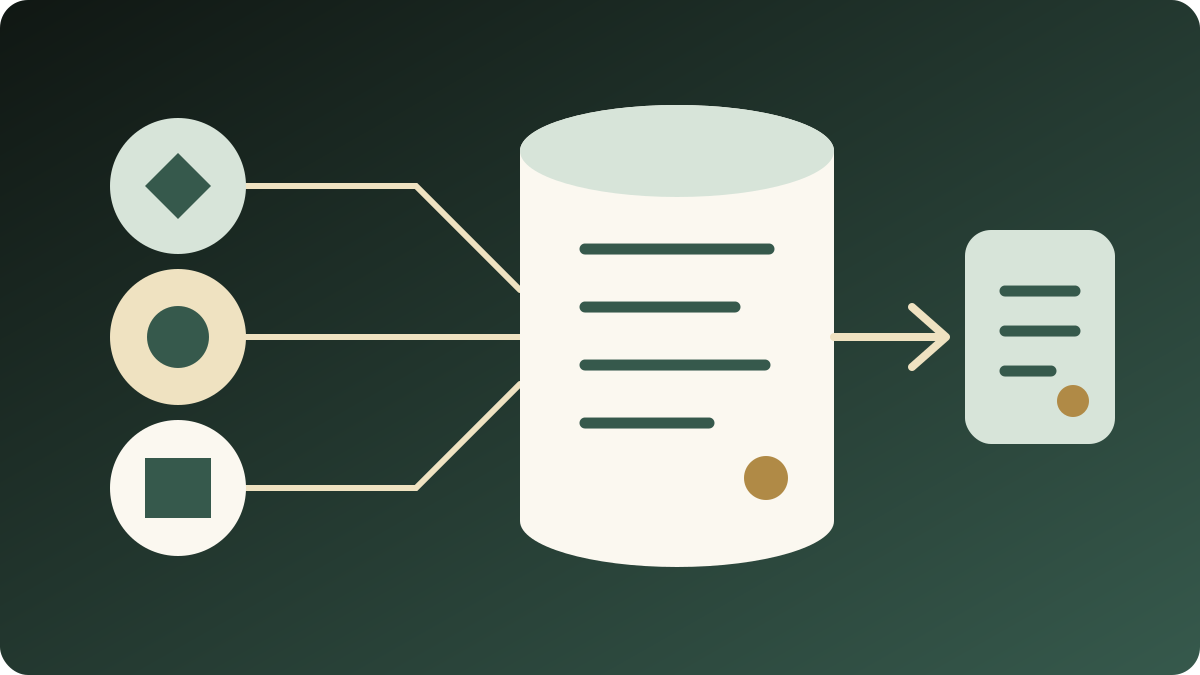
KnowSales is not another general-purpose foundation model, and it does not need to reproduce the chat experience of ChatGPT, Claude, or Cowork. It sits between those AI workspaces and sales data, organizing customer records, product knowledge, communication history, citations, and the MCP tools that are currently enabled.
Salespeople and consultants can therefore use strong search, reasoning, and tool chains in the AI workspace they already know, then capture reviewed industry experience, product knowledge, customer facts, and follow-up records back into KnowSales. Changing the model does not require rebuilding account memory.
The boundary remains important. Tool compatibility, context limits, file features, and pricing still vary by model provider. Generated content should be reviewed in proportion to its business impact.
Related reading
- How to Connect AI to Your Sales Knowledge Base with MCP
- Why AI Sales Answers Need Source Citations
- Best Sales Knowledge Base Software in 2026
Next step
If you want Codex, Claude Code, Cowork, WorkBuddy, Qwen, or another compatible workspace to use one durable sales memory, connect your AI workspace to KnowSales.
This article uses official model announcements to describe product direction and does not rank vendors by benchmark. Model names, availability, and capabilities should be rechecked on official pages.