Web Search Plus Company Knowledge: A Better AI Account Research Workflow
Combine current web information with internal customer history without mixing public signals, CRM facts, and AI inference into one unsupported conclusion.
The short answer
Web-only account research is current but often disconnected from your commercial history. CRM-only research is grounded in your relationship but may miss what changed yesterday.
A better AI account research workflow keeps both evidence sets visible:
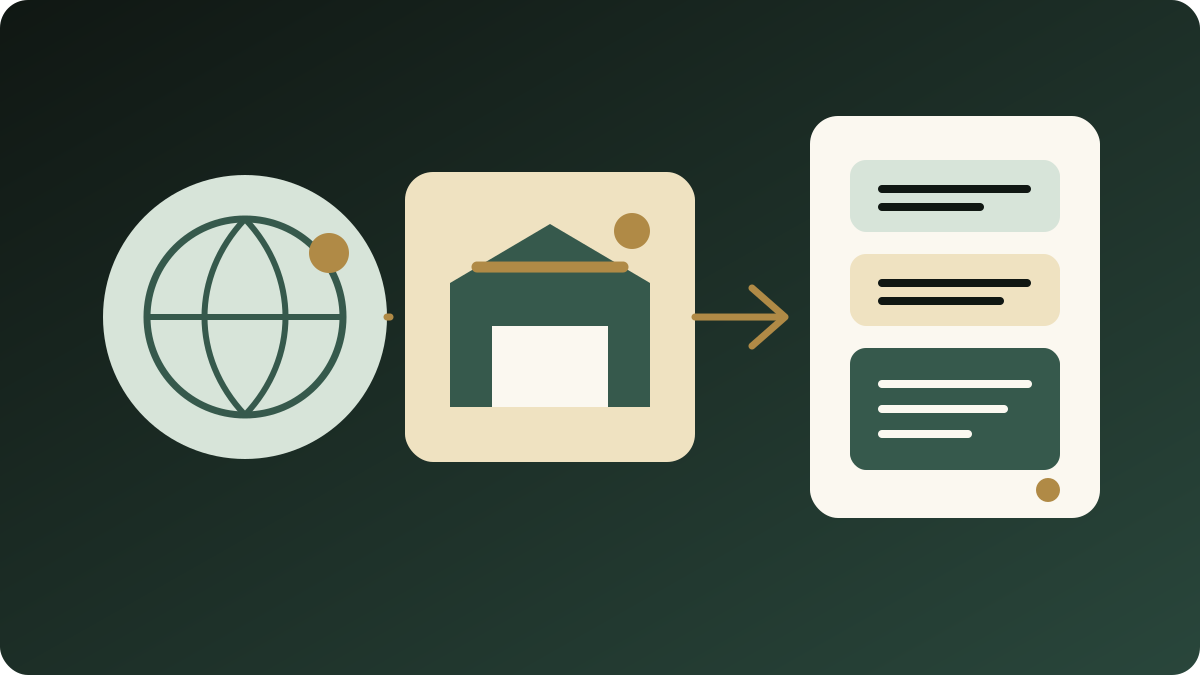
- public web information explains what is happening at the company now;
- internal sales knowledge explains what has happened between the account and your team;
- AI connects relevant signals, exposes gaps, and proposes questions without blending everything into an unsupported conclusion.
Why web search alone is not enough
Public search can surface a company's official site, new announcements, leadership changes, product launches, and market activity. It also creates identity and evidence risks:
- companies with similar names may be merged;
- a distributor page can rank above the manufacturer's official site;
- a job listing or old article does not prove current buying intent;
- aggregators can repeat an unverified claim across many domains;
- a public brand name may not match the legal entity in your CRM.
The first step in web research should therefore be entity verification, not summarization. Formal company name, official domain, geography, and business email are useful anchors.
Why internal knowledge alone is not enough
CRM and activity history can show past inquiries, contacts, quotations, and follow-ups. They may not capture a new plant announcement or product expansion published this week.
Suppose Customer Company B paused a project six months ago. Its official site now announces a new facility. That is a useful trigger for a conversation, but it is not evidence that the paused purchase has restarted.
OpenAI's Company Knowledge emphasizes connecting information across enterprise applications, while Google Workspace Intelligence reflects the push to bring organizational context into AI. For sales teams, the important design choice is not the number of connected sources. It is the evidentiary role assigned to each source.
A four-layer account research model
| Layer | Main question | Typical evidence | Required output |
|---|---|---|---|
| Entity | Are these records about the same company? | Official site, domain, business email, location | Matching basis |
| External change | What happened recently? | Official news, filings, hiring, credible media | Date and link |
| Internal relationship | What happened between us? | Customer profile, activities, quote history | Original record links |
| Action | What should the seller do next? | Intersection of the first three layers | Facts, inference, and open questions separated |
If entity verification fails, internal customer data should not be merged into the research.
A synthetic example: a new webpage is not buying intent
An AI system notices that Customer Company C has added a new business page to its official site. Internal activity shows that the customer once asked about an adjacent solution.
An over-automated system might state: “The account is expanding this business and is ready for a new quote.”
A safer research brief says:
- public fact: the official site added or updated the page on a specific date;
- internal fact: the account has a historical activity related to an adjacent need;
- inference: the signals may be related, but there is no confirmed purchase;
- next step: ask about priority, scope, and timing using the public update as context;
- prohibited action: do not update stable demand or probability without confirmation.
Current information is used without pretending to be customer truth.
How KnowSales approaches web research
The KnowSales Agent workspace separates web sources from company knowledge and supports distinct search strategies:
- auto for questions that clearly need current public information;
- force when the user specifically requests website or recent-news verification;
- off when the answer must use internal knowledge and customer history only.
The verified path also uses company names and domains as entity anchors and preserves web citations. The current /home web-search path is read-only, so it does not overwrite customer profiles or activities; any durable finding must move to a separate write workflow.
Its limitations remain important: web search cannot prove a customer's private decision, pages can change, and third-party sources may have commercial incentives. The general Agent approval-and-write loop is not yet enabled, so durable updates still require explicit human review and a separate write tool.
A reusable AI account research prompt
Target account: Customer Company A
Entity anchors: formal name, official domain, country or region

Return separately:
1. official website and announcement changes from the last 12 months;
2. public signals relevant to our product or solution;
3. existing KnowSales profile and recent customer activities;
4. conflicts or gaps between public and internal evidence;
5. three questions the seller should confirm with the account.

Rules:
- cite every public fact with a link and date;
- never present inference as customer fact;
- do not update CRM automatically.
Quality checklist
- Was the business entity verified with an official domain?
- Were first-party sources prioritized?
- Are third-party claims labeled as such?
- Are external developments separated from internal account facts?
- Does every time-sensitive signal show a date?
- Are proposed actions described as recommendations rather than commitments?
- Does every durable write wait for user confirmation?
Related reading
- Why AI Sales Answers Need Source Citations
- Why Sales Teams Need Context Engineering
- From WhatsApp and WeChat Threads to Sales Memory
Next step
If you need current company signals and durable account history in one workflow, explore KnowSales for export sales teams.
This article is based on internal acceptance evidence for the KnowSales web-search path. All company examples are synthetic.