Why AI Sales Answers Need Source Citations: From Fluent to Verifiable
AI sales answers should be traceable, not merely fluent. Learn how citations reduce sales risk and what to test before choosing an AI assistant.
The short answer
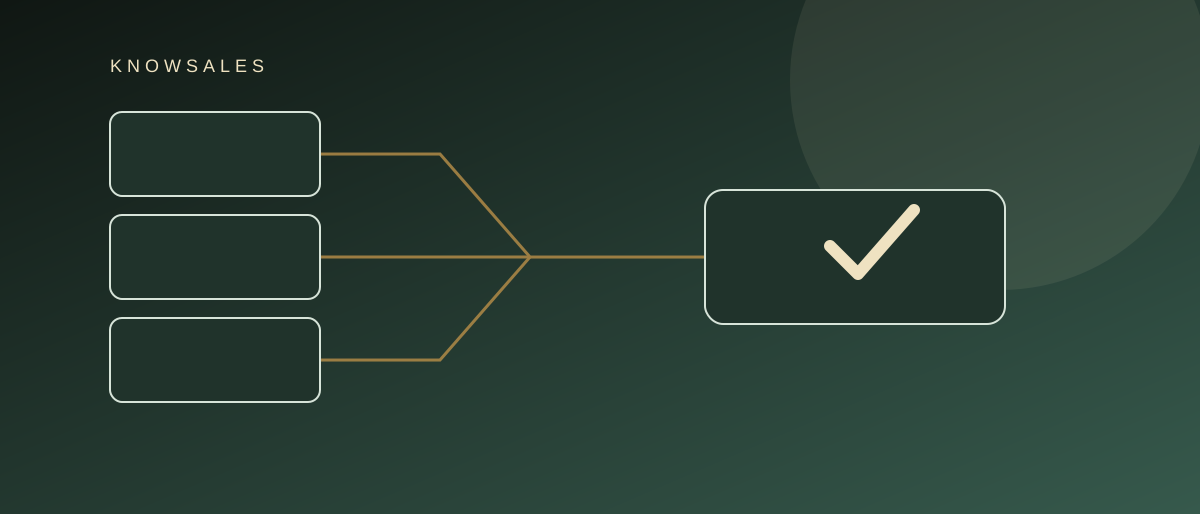
An AI sales assistant should not be judged only by whether it produces a polished answer. It should be judged by whether a seller can verify that answer before acting on it.
When an answer involves a product specification, account history, payment term, delivery commitment, or company policy, a vague phrase such as “based on your knowledge base” is not enough. The assistant should show which document, customer activity, or external page supports each material claim.
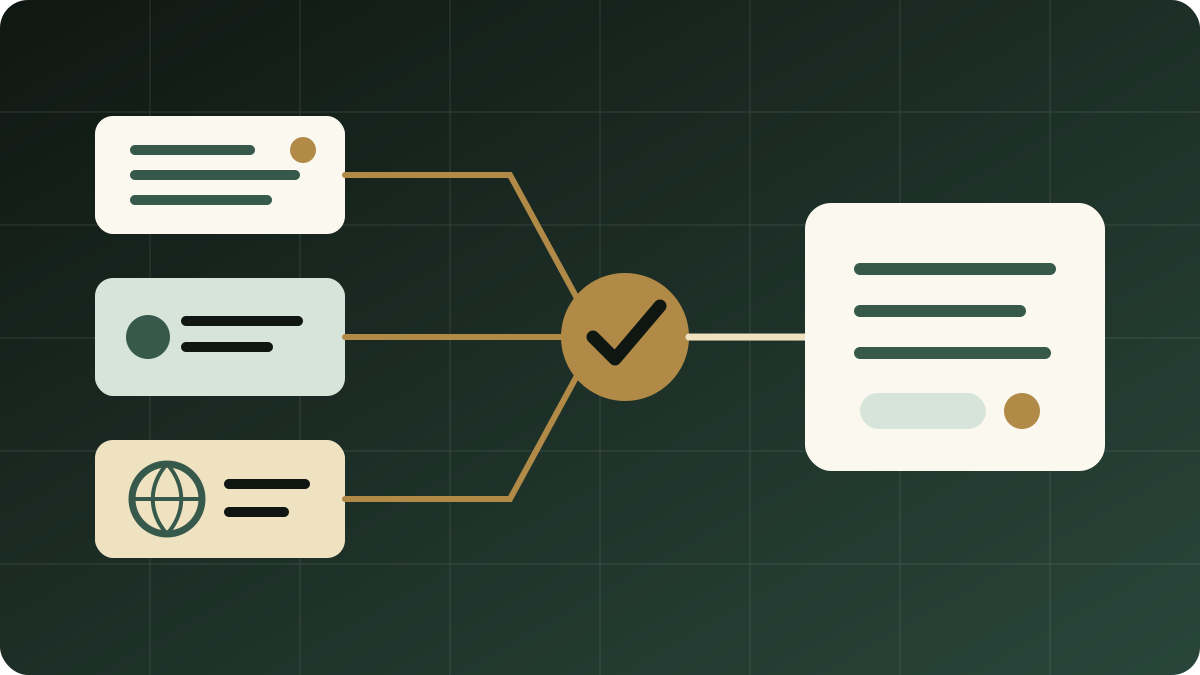
A useful citation system does three things:
- separates company knowledge, customer history, and public web sources;
- lets the user open the original evidence at the relevant object or passage;
- clearly says when evidence is missing instead of completing a plausible story.
Why citations matter more in sales
Sales questions often lead directly to action.
Imagine a rep asks, “Why did Customer Company A stop moving forward?” The assistant answers, “Budget constraints were the primary reason.” That statement could have come from four very different places:
- the customer explicitly said its budget was frozen;
- a rep recorded budget as an internal judgment;
- a different account had a similar objection;
- the model inferred a common sales pattern.
Those sources are not equivalent. Without a citation, the rep cannot tell whether to discuss budget, requalify the opportunity, or inspect the original conversation first.
This is part of a broader enterprise AI shift. OpenAI's Company Knowledge emphasizes answers grounded in connected company applications. Notion's Enterprise Search also positions permission-aware search and traceable answers as core parts of enterprise knowledge work. The important change is not making AI sound more certain. It is making its reasoning easier for people to check.
A citation is more than a link at the bottom
A practical sales citation system needs both evidence granularity and business identity.
| Citation design | What the seller can verify | Remaining risk |
|---|---|---|
| File name only | The approximate source | A long file is still hard to check |
| Web URL | The public page | The page can change and may not reflect internal policy |
| Section or spreadsheet range | The specific evidence | Parsing and anchors must remain stable |
| Customer activity link | The exact account event | Customer identity and permissions must be correct |
| “Inference” label | That the statement is not direct evidence | A human still decides whether to act |
This means citations are not a decorative front-end feature. The system must preserve source objects, identity, access control, and useful locations within the evidence.
A synthetic example: the conclusion sounds right, but the evidence is wrong
A rep asks, “Has Customer Company B accepted remote implementation?”
The system finds two items:
- an account activity saying the customer asked for network prerequisites;
- a general implementation guide saying remote delivery is possible when prerequisites are met.
An unsafe assistant merges them into: “The customer has accepted remote implementation.”
A verifiable answer would say:
Remote implementation is supported under documented conditions. Customer Company B has asked about prerequisites, but the account record does not yet show acceptance.
It should cite the implementation knowledge and the customer activity separately. Product capability, customer commitment, and the open question remain distinct.
How KnowSales handles sources
KnowSales is designed to connect citations to sales knowledge objects rather than add an unexplained footnote number.
The currently verified citation path includes:
- structured sources for company-knowledge answers;
- deep links to relevant customer activities;
- separation between web findings and internal knowledge;
- original knowledge retained in its underlying object for further review.
This path proves traceability. It does not guarantee that a model will detect every conflict, label every inference correctly, or always stop when evidence is insufficient. A source may also be stale, unverified, or an internal judgment, so knowledge governance and human review still determine whether the material should be trusted.
Seven tests for an AI sales assistant
- Does it cite a specific source? “From your knowledge base” is too broad.
- Can the user open the original object? Look for a section, range, or customer activity.
- Does it separate internal and external evidence? A press release should not silently override internal policy.
- Does retrieval respect permissions? AI must not become a side door into restricted account data.
- Are inferences labeled? Customer words, rep judgment, and model reasoning are different evidence types.
- Does it expose conflicts? When two documents disagree, the disagreement should remain visible.
- Does writeback require confirmation? A cited answer is not automatically safe to store as CRM truth.
How to test citations with real work
Do not stop at a product demo that shows footnote icons. Build a small set of ten de-identified questions:
- three should resolve to customer history;
- three should resolve to product or policy documents;
- two should include deliberately conflicting sources;
- two should not have enough evidence for an answer.
Then check whether the assistant retrieves the right object, exposes conflicts, and stops when the evidence is insufficient. That test is much closer to actual sales risk than “the answer looked good.”
Related reading
- Before an AI Agent Writes to CRM, Require a Write Plan
- How to Build an Effective Sales Knowledge Base
- From WhatsApp and WeChat Threads to Sales Memory
Next step
If your team needs verifiable answers across product knowledge and account history, explore KnowSales for B2B sales teams.
This article is based on internal acceptance evidence for the KnowSales structured-citation path. All examples are synthetic and contain no customer data.