Giving Your AI Sales Agent Persistent Memory with MCP: The Three-Layer Architecture
A practical three-layer architecture for giving AI sales agents persistent memory with MCP, SalesFlow, KnowSales, and lightweight tracking.
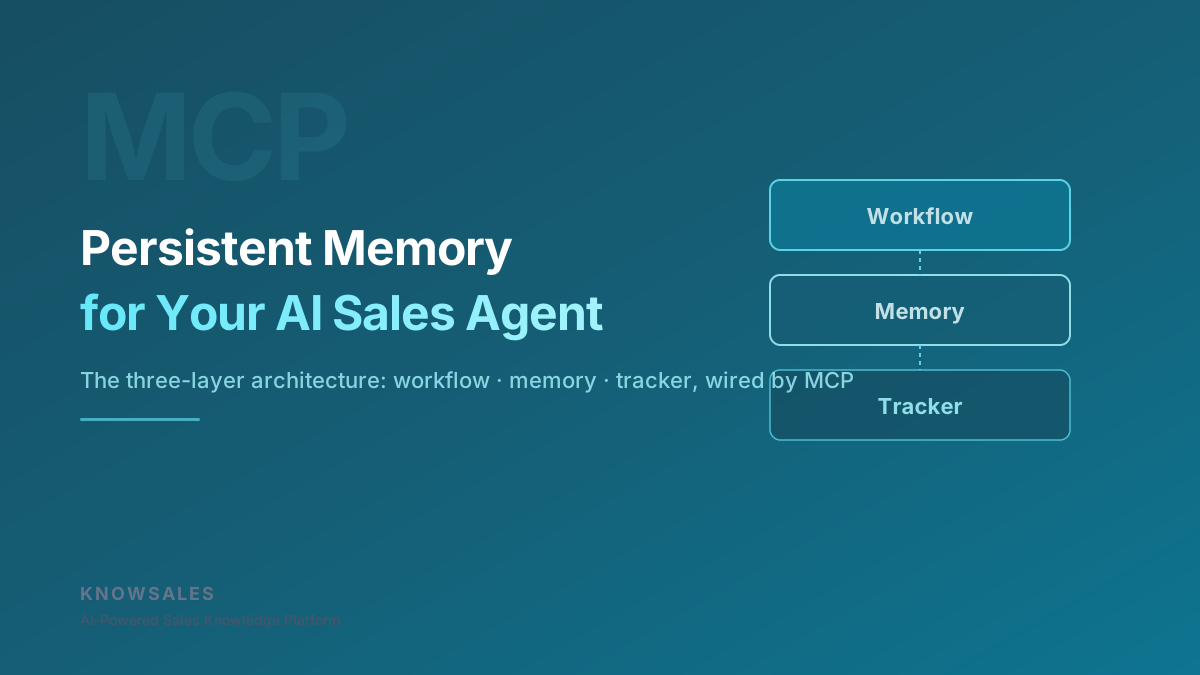
The Biggest Weakness of AI Sales Assistants Is Amnesia
Have you noticed that even the smartest AI sales assistant shares one flaw: it can't remember anything.
- Last week you explained a customer's procurement process in detail; this week it stares back blankly.
- Your top rep taught the AI an objection-handling playbook; by the time the next new hire uses it, the AI has forgotten it all.
- It can draft a beautiful email, but the email self-destructs — the judgment behind it and the customer's reaction leave no trace.
The root cause isn't a weak model. It's architecture: most AI tools fuse "doing the work" and "remembering" into one blob, so every conversation starts cold.
To cure amnesia, you first have to take the architecture apart.
The Three-Layer Architecture: Separate "How to Do It" From "What to Remember"
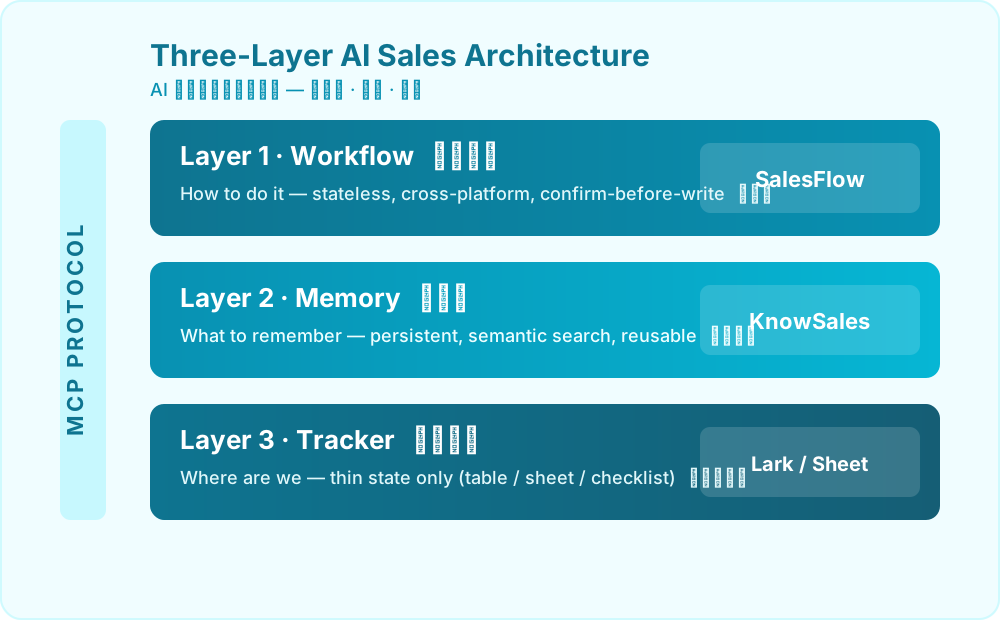
A sales AI system that actually compounds over time should be three layers, not one blob:
Layer 1: The Workflow Layer (How to Do It)
Turns a vague sales request into standard actions. It's stateless — it only cares about running the current task correctly and remembers nothing.
SalesFlow is a textbook workflow layer: account research, call summaries, follow-up drafting, quote readiness — 8 workflows that start from evidence, separate fact from judgment, produce a draft, present a write plan, and wait for your confirmation.
Layer 2: The Memory Layer (What to Remember)
Handles long-term accumulation. Customer profiles, follow-up activities, product knowledge, objection scripts, competitor intelligence — this "thick" information needs a place that persists, supports semantic search, and is reusable across conversations.
KnowSales is a memory layer built for sales: an MCP-native sales knowledge base that any MCP-capable AI can read from and write to directly.
Layer 3: The Lightweight Tracker (Thin State)
Records lightweight status like "where are we right now" — who to follow up, when, what's blocked. It holds no thick information, just pointers and state. A Feishu/Lark table, a single spreadsheet, even a simple checklist can fill this role.
The key principle: thick information goes to the memory layer, thin state goes to the tracker, and the doing-logic stays in the workflow layer. Each layer does its job — none of them substitutes for another.
MCP: The "USB-C" That Connects the Three Layers
Once the layers are separated, how do they cooperate? The answer is MCP (Model Context Protocol).
MCP is a standard protocol introduced by Anthropic — think of it as the "USB-C of the AI world":
- Whether you use any MCP-capable AI client
- Whether your data lives in a knowledge base, CRM, or email system
- As long as both sides support MCP, they connect seamlessly
KnowSales supports MCP natively, so any AI client you already use can connect directly to your sales knowledge base. Once connected, plain language is all you need:
🔍 Search Knowledge
"What's the best script for handling a pricing objection?"
The AI searches your playbook and returns the most relevant response strategy.
📝 Store Knowledge
"Save this competitive analysis to my knowledge base."
The AI identifies the content type and files it in the right category automatically.
👥 Manage Customers
"Log my meeting with Mr. Zhang today — he's very interested in the new solution and wants a demo next week."
The AI updates the customer profile and adds a follow-up record instantly.
In Practice: SalesFlow + KnowSales End to End
With the workflow layer and memory layer connected, a complete customer follow-up looks like this:
1. You paste a WeChat/email thread with a customer
2. SalesFlow's communication-summary workflow:
   - Extracts hard facts (customer's words, amounts, model, lead time)
   - Separates judgment ("he'll probably order" -> labeled as judgment, not fact)
   - Produces a "write plan": which customer fields to update, which activity to add
3. You review and confirm (or edit)
4. SalesFlow calls KnowSales via MCP and writes the confirmed content
5. KnowSales reads the result back, you verify it
Next time any AI connects to KnowSales, the information is there — for the first time, your team's sales experience actually lives in the system, not in one person's head.
Connect KnowSales MCP in Three Minutes
Step 1, get your API key:
- Log in to KnowSales
- Go to Settings → AI Connections
- Click Create API Key and copy it (format:
ks_mcp_xxxx...)
Step 2, add it to your AI tool. For Claude Desktop:
{
  "mcpServers": {
    "knowsales": {
      "url": "https://knowsales.ai/api/mcp",
      "headers": {
        "Authorization": "Bearer YOUR_API_KEY"
      }
    }
  }
}
Client setup paths change as platforms evolve, so use our complete MCP setup guide as the maintained reference.
Why "Layered" Beats "All-in-One"
You might ask: why not build one all-in-one tool that both does the work and holds the memory?
Because coupling is fragility.
- Bind workflow to memory, and you can't switch AI platforms — Claude today, ChatGPT tomorrow, your memory has to come along.
- Bind memory to a single product, and your data becomes a hostage.
- All-in-one tools tend to do everything shallowly — the workflow isn't rigorous enough, the memory isn't searchable enough.
A layered architecture gives you the opposite: every layer is replaceable and can evolve independently. SalesFlow is vendor-neutral and works without KnowSales; KnowSales is MCP-native and readable by any AI. That's what it looks like when the data truly belongs to you.
Summary
AI sales assistants aren't unintelligent — they're amnesiac. The cure is to split the system into three layers:
- Workflow layer (SalesFlow) — owns "how to do it": stateless, cross-platform, confirm-before-write
- Memory layer (KnowSales) — owns "what to remember": MCP-native, persistent, semantically searchable
- Lightweight tracker — owns "where are we": thin state only
Connect them with MCP, and your team's sales experience finally turns from fragments into reusable assets.
If your intake starts from WhatsApp or WeChat threads, continue with: From WhatsApp and WeChat Threads to Sales Memory.
👉 Connect KnowSales MCP now and give your AI sales assistant a brain that actually remembers.