An AI Sales OS Is Not Another CRM: The Layered Workflow Stack Sales Teams Actually Need
A layered AI Sales OS stack for B2B teams: source evidence, workflow, sales memory, lightweight tracking, and specialist modules.
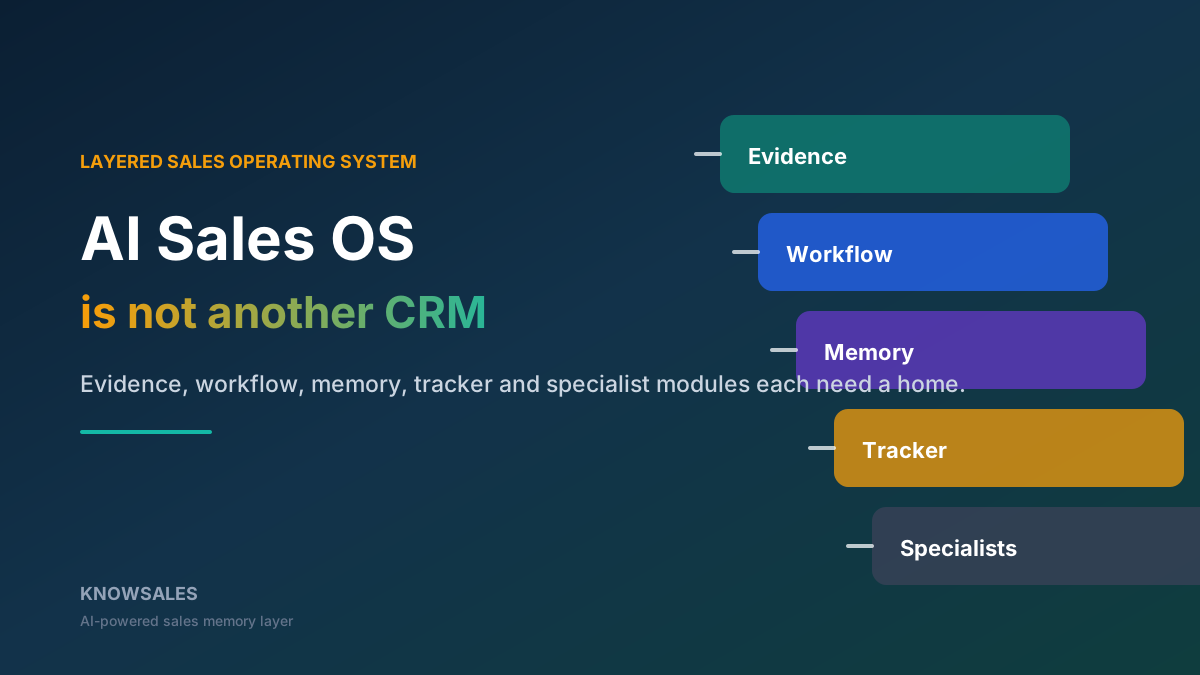
The sales system you need is not a bigger table
When people hear "AI for sales operations," the default answer is usually: build a smarter CRM.
But for long-cycle B2B and export sales teams, the failure mode is often the opposite. Everything gets pushed into one place: raw customer chats, rep judgment, manager dashboards, product knowledge, quotation inputs, support issues, and personal process notes. The result is a large system that no one trusts enough to maintain.
AI makes that worse if the architecture is wrong. An agent that reads chats, identifies customers, updates records, writes emails, and prepares quote inputs all in one motion can easily mix what the customer actually said with what the rep inferred and what the system should remember.
The better pattern is not an all-in-one AI CRM. It is a layered AI Sales OS.
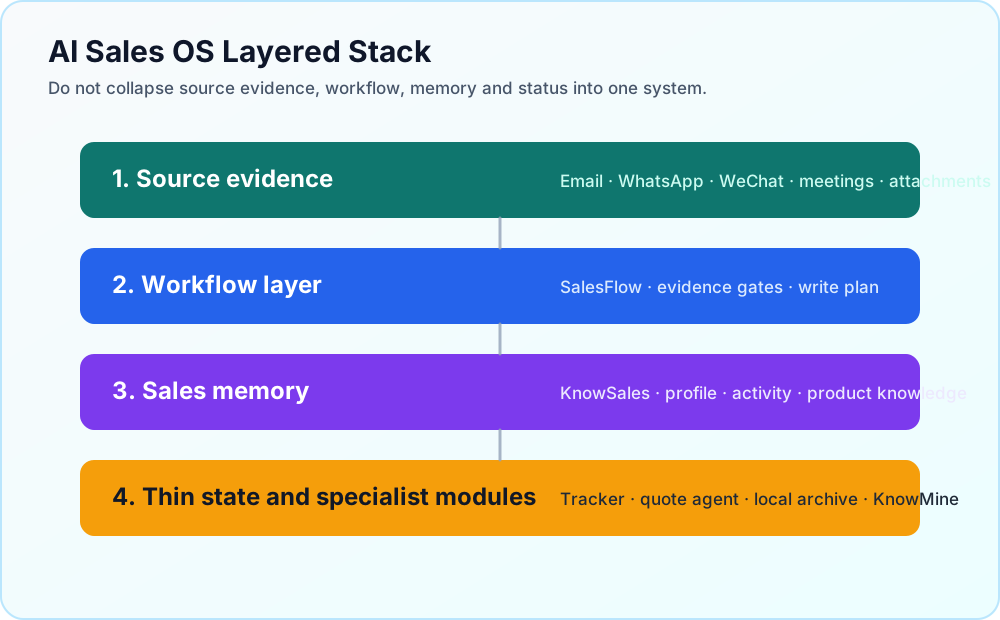
Layer 1: Source evidence
Source evidence includes email, WhatsApp, WeChat, meeting notes, call transcripts, attachments, and quotation exchanges.
The rule here is simple: do not rewrite too early.
A customer thread can contain direct statements, rep assumptions, historical references, forwarded comments, jokes, and partial confirmations. If you collapse all of that into "the customer wants Machine X," every downstream decision is built on a fragile summary.
Source evidence should stay in its original archive or a traceable local evidence layer. AI can read it, extract from it, and cite it, but raw long-form conversation streams should not be dumped directly into your sales knowledge base.
Layer 2: Workflow
The workflow layer owns how the work is done.
This is where SalesFlow fits. It is not a CRM and not a knowledge base. It turns a vague sales request into a standard, confirmable sequence:
evidence -> identity check -> fact/judgment split -> seller artifact -> write plan -> confirmation -> readback
If a rep says, "help me decide how to follow up with this account," the workflow layer should not immediately update the customer profile. It should decide whether this is account research, communication summary, follow-up drafting, quote readiness, or a combination, then list the evidence, identity signals, and open questions.
The more disciplined this layer is, the cleaner your sales memory becomes.
Layer 3: Sales memory
The sales memory layer owns what should be remembered.
KnowSales is the thick sales memory layer in this stack: customer profiles, follow-up activities, product knowledge, competitor intelligence, objection cards, quotation rules, and durable sales judgment belong here.
The boundary matters:
| Material | Right destination |
|---|---|
| A payment term discussed by one customer on June 30 | Customer activity |
| Stable company identity, contacts, and machine interest | Customer profile |
| Reusable service-fee objection response | Objection card / sales playbook |
| Product parameters and fit boundaries | Product knowledge |
| A personal process lesson | KnowMine or personal knowledge layer |
The value of an AI Sales OS is not that it stores more. It stores the right thing in the right place after confirmation. Next time an AI agent answers a customer question, it can retrieve durable sales memory from KnowSales instead of guessing from old summaries.
Layer 4: Lightweight tracking
Sales management still needs thin state: owner, stage, next follow-up date, risk level, whether a record needs to be written back to KnowSales.
That layer can live in Lark/Feishu Base, a spreadsheet, an existing CRM pipeline, or a team dashboard. It should not carry thick business memory. Its job is to answer: where are we right now?
Then managers can see progress, reps can see reminders, and AI can see next actions without polluting customer memory.
Layer 5: Specialist modules
Some jobs should remain specialist modules:
- Quote generation stays with a quotation agent and workbook checks.
- Customer-readable reports belong in the local customer archive.
- Cross-project methodology belongs in KnowMine.
- Raw chat and email streams stay in the evidence layer.
That is not fragmentation. It is risk control. A wrong quote is a money problem. A wrong customer identity is a trust problem. A rewritten source record is a traceability problem.
Why this matters for export sales
Export sales is naturally multilingual, multi-channel, long-cycle, and collaborative.
A customer may send a WhatsApp message today, reply by email tomorrow, send drawings next week, and ask for a quotation at the end of the month. The thread may involve distributors, end users, engineering checks, payment terms, delivery, installation, and after-sales service.
If all of that becomes one universal "customer note," AI soon loses the distinction between:
- confirmed facts;
- rep judgment;
- one-off activities;
- reusable product knowledge;
- thin dashboard state.
Layering gives each category a home. That is what allows AI to become a reliable sales assistant instead of a faster way to write mistakes into your systems.
Summary
The point of an AI Sales OS is not to make AI do everything. It is to make AI work in the right layer.
SalesFlow owns workflow. KnowSales owns thick sales memory. Lightweight trackers own status. Quotation agents and local archives own specialist outputs and traceability. Together, they form a sales operating system that can compound instead of sprawl.
For the memory side of this stack, read the companion post: Giving Your AI Sales Agent Persistent Memory with MCP.