How to Share Product Knowledge Securely with Partners Using MCP
A least-privilege approach to letting partners use verified product knowledge from familiar AI workspaces while controlling scope, tools, revocation, and audit.
TL;DR
The riskiest way to give a distributor product knowledge is to hand over an entire internal workspace or a general-purpose API key.
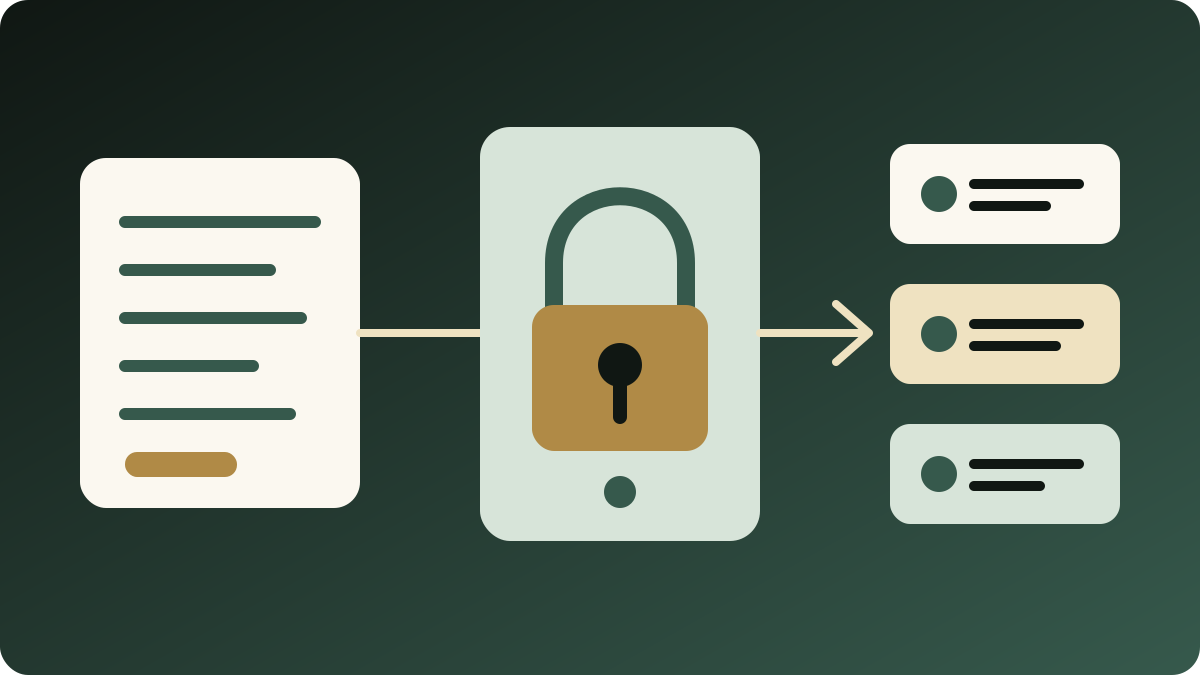
A safer design publishes a separate set of shareable knowledge, exposes only a few read-only tools, issues revocable credentials, and prevents external users from reading customer data or writing to internal systems.
The Model Context Protocol (MCP) gives compatible AI clients a standard way to call knowledge tools. The protocol standardizes the connection; your application still has to enforce the boundary.
The better experience is not to force every partner into another knowledge-base interface. It is to let them remain in a familiar AI workspace while KnowSales provides a narrowly scoped, revocable knowledge path.
Why a shared folder is no longer sufficient
Partner material often lives across drives, attachments, and chat groups. The recurring problems are familiar:
- outdated specifications remain in circulation;
- partners do not know which file name to search;
- internal comments and external material get mixed;
- downloaded files are difficult to revoke;
- an AI assistant cannot consistently decide what it is allowed to answer.
As MCP becomes a common way to connect AI tools and data, a partner can search approved product knowledge from an MCP-compatible client. But this turns a file-sharing problem into an agent-permission problem.
What least privilege needs to control
At least four dimensions matter:
| Dimension | Governance question |
|---|---|
| Content | Which knowledge items are verified and shareable? |
| Tools | Can the external user search and read only, or also modify? |
| Identity | Which credential belongs to which partner, and can it be revoked independently? |
| Audit | Can you see which tool was called and where the answer came from? |
Controlling only one dimension is insufficient. A “partner-visible” label does not protect the system if the credential can still invoke an internal write tool.
A synthetic partner scenario: only three capabilities are needed
Partner Company A wants to use its own AI client to answer three questions:
- Which product-knowledge categories are available?
- Which approved material relates to an application requirement?
- What is the full content of a selected published knowledge item?
It does not need the internal customer list, other partners' activity, or permission to edit product knowledge.
A well-scoped interface can therefore expose only three read-only actions:
- search shared knowledge;
- retrieve one shared knowledge item;
- list permitted categories.
When the commercial relationship ends, revoking that partner credential should cause subsequent requests to be rejected immediately.
The KnowSales shared-knowledge MCP boundary
The verified KnowSales shared-knowledge MCP foundation follows a deny-by-default publishing model:
- an external shared credential sees exactly three read-only tools;
- only verified, published, audience-permitted knowledge is retrievable;
- internal write tools and legacy broad-access tools are absent from the external tool list;
- revoked credentials are rejected;
- results retain a knowledge object and source path for verification.
This foundation is not the same as a complete partner portal. It does not, by itself, provide a full invitation UI, contract entitlement system, or partner relationship management suite. An organization still needs rules for who approves publication, when content expires, and which knowledge must remain internal.
Separate internal two-way workflows from external read-only sharing
The KnowSales team has continuously used MCP from Codex, Claude Code, Cowork, WorkBuddy, and Qwen to retrieve and write customer profiles, sales product knowledge, and follow-up records. That internal workflow demonstrates the value of keeping a familiar AI workspace while adding durable sales context.
It does not justify giving partners write access. Internal sales users can receive specific write tools according to workspace role and API-key allowlist. External partner credentials should continue to see only the three approved shared-knowledge read tools. The same protocol does not imply the same permission level.
The client list above reflects real KnowSales user workflows, not certification by those client vendors. Each external connection still needs an independent tool-list, scope, denied-access, and post-revocation test.
A six-step publishing workflow
- Classify knowledge as internal, partner-visible, or public.
- Verify specifications, conditions, version, and content owner.
- Publish only approved items into the shareable set.
- Authorize each partner with an independent, revocable credential.
- Connect the partner's compatible AI client to the shared endpoint only.
- Review stale knowledge, access scope, and unused credentials on a schedule.
If verification lacks evidence, publication should not proceed.
Ten checks before launch
- Is sharing disabled by default?
- Does content require verified, published, and permitted-audience status?
- Does the external tool list contain only necessary read-only tools?
- Are customer profiles, activities, and internal seller notes fully isolated?
- Does each partner have a separate credential?
- Can each credential be revoked immediately?
- Is revocation verified with a real rejected request?
- Is scope enforced in retrieval rather than hidden only in the interface?
- Are tool calls and failures logged?
- Is there a review process for stale knowledge?
MCP versus a shared drive
A shared drive still works well for complete manuals, installation packages, and formal files that must be downloaded. MCP is better suited to letting an AI system search, retrieve, and combine governed knowledge within an authorized scope.
They can work together:
- authoritative files remain in a controlled file system;
- governed knowledge summaries are available through MCP;
- answers link back to their source material;
- external AI receives only the minimum context required for the task.
Related reading
- How to Connect AI to Your Sales Knowledge Base with MCP
- How to Build an Effective Sales Knowledge Base
- AI Agent Governance for Sales Teams
Next step
To evaluate a least-privilege knowledge interface for distributors, partners, or external AI clients, connect your AI workspace to KnowSales and validate the content and permission boundary first.
This article is based on production acceptance evidence for the KnowSales shared-knowledge MCP foundation. It includes no real credentials, customers, or partner data.