What Should a Sales Knowledge Base Include? A Practical 8-Category Checklist
A hands-on checklist for building a sales knowledge base that reps actually use: from product knowledge and objection scripts to competitive battlecards and onboarding materials — plus what to leave out and how to keep it fresh.
Why Most Sales Knowledge Bases Fail
Most sales knowledge bases fail not because they were never built, but because the wrong things were put inside them.
There are two common failure patterns:
Too scattered. Product decks, price lists, contract templates, and company brochures all dumped in one place. When reps need something specific, they cannot find it fast enough, so they stop trying.
Too generic. Full of principles with no practical traction. "When facing a price objection, emphasize value" — every sales rep already knows this, but it does not help them when they are on a call.
A useful sales knowledge base answers a concrete question: When a rep faces a specific customer question or situation, can the knowledge base give them a credible, usable answer?
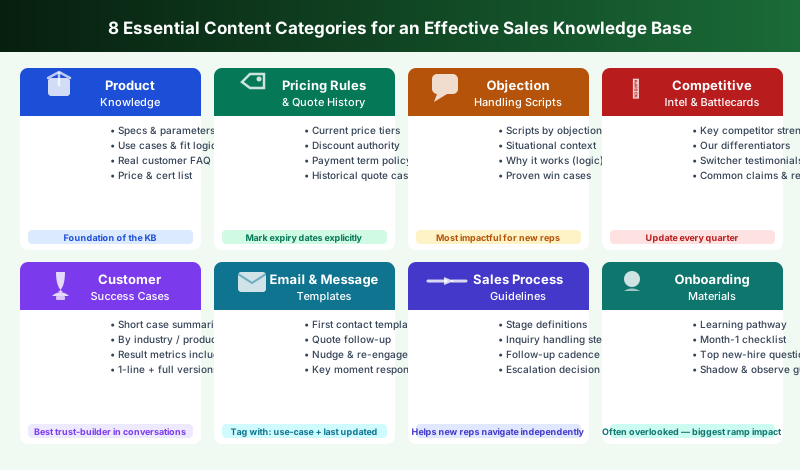
The eight categories below are what a knowledge base needs to contain to actually help sales work.
Category 1: Product Knowledge
This is the foundation. But many teams build product knowledge sections that are not sales-friendly — the content exists, but it was written for engineers, not for customer conversations.
What to include:
- Product specs and parameters written in customer language, not internal technical jargon
- Core use cases and target customer descriptions for each product
- FAQ compiled from real customer questions with verified answers
- Product-to-use-case matching logic (which customer type fits which solution)
- Current pricing structure and quantity tiers
- Certified specification sheets and a list of valid certifications
What to leave out:
- Unfiltered internal technical documentation (too slow for reps to parse under pressure)
- Price lists without expiration dates (stale prices are dangerous)
Category 2: Quoting Rules and Historical Quote Reference
Quoting is one of the highest-frequency and highest-risk tasks in sales. Mistakes here have direct commercial consequences.
What to include:
- Current standard quoting logic, including currency and Incoterms
- Quantity tiers and discount authority levels
- Payment terms policies for new versus returning customers
- Historical successful quotes archived by customer type or product
- Quote validity period rules
Critical point: Historical quotes must be explicitly labeled as historical. This is one of the most common sources of knowledge pollution in export and B2B sales knowledge bases — a rep cites a price that was valid eighteen months ago, and the damage is immediate.
Category 3: Objection Handling Library
This category has the most direct impact on front-line sales performance. It is also the hardest to build well.
What to include:
- Response approaches organized by objection type (price, competitor, decision authority, timing, trust)
- Context notes for each approach: what type of customer, at what stage in the cycle
- The reasoning behind each approach, not just the script — reps need to understand the logic to adapt it
- Real examples: which approach was used, how the customer responded, what the outcome was
What to leave out:
- Unvalidated theory scripts that sound reasonable but have never been tested with real customers
- Corporate-sounding language that no sales rep would actually say out loud
A good objection handling library does not give reps lines to memorize. It gives them frameworks and examples so they can adapt to the actual conversation.
Category 4: Competitive Intelligence and Battlecards
Customers compare. If reps are not prepared for competitive objections, they will be reactive instead of confident.
What to include:
- Honest assessment of main competitors' strengths and weaknesses (not attack-style, but accurate)
- One to three core differentiators against each competitor, phrased for use in live conversations
- Feedback from customers who switched from a competitor (if available)
- Common things competitors say about you and how to respond
Critical point: Battlecards go stale fast. Competitor products, pricing, and positioning change. A battlecard that has not been reviewed in six months can actively mislead reps.
Category 5: Customer Success Stories
Case studies build trust faster than any other content type. The problem is that most teams either have too few or format them in ways that are impossible to use in a real conversation.
What to include:
- Short case summaries: customer background, core problem, how you solved it, key outcome numbers
- Organized by industry, customer type, and product so reps can quickly find the closest match
- Two versions of each case: a one-to-two sentence oral version for conversations, and a detailed version for email attachments
Category 6: Email and Message Templates
Reps write a large volume of repetitive emails and WhatsApp messages. High-quality templates improve both speed and consistency.
What to include:
- First-contact outreach templates
- Quote follow-up templates (for after a quote has been sent)
- Stage-specific nudge templates (check-in, urgency, next step)
- Response templates for common situations (e.g., buyer says "let us think about it")
- Multilingual templates for foreign trade teams that handle multiple markets
Critical point: Every template should be labeled with the situation it fits and the date it was last updated. A template used out of context can do more harm than no template at all.
Category 7: Sales Process Guides
New reps' most common frustration is not knowing what to do at each stage. Process guides remove that uncertainty.
What to include:
- Standard sales process stage definitions and the goal of each stage
- New inquiry handling workflow (from receiving an inquiry to sending a quote)
- Customer follow-up cadence recommendations (how often, through which channel)
- Decision trees for common judgment calls (e.g., when to involve a manager, when to offer a trial order)
Category 8: Onboarding Material for New Reps
This category is often neglected or buried in an onboarding folder that new hires open once and never return to.
What to include:
- A recommended product learning sequence (what to study first, what comes next)
- A checklist of core knowledge to master in the first month
- A FAQ for new reps — the most common questions they ask, with verified answers
- A structured observation guide for shadowing experienced reps
What Not to Put in a Sales Knowledge Base
Defining the boundary is as important as defining the content.
| Do not include | Reason |
|---|---|
| Raw customer emails or chat logs without anonymization | Privacy risk and too much noise |
| AI-generated content with no source verification | Cannot be trusted; may mislead reps |
| Historical information with no expiration label | Will be treated as current |
| Internal execution and process records unrelated to sales | Adds noise, dilutes signal |
| Company news unrelated to sales conversations | Increases volume, reduces quality |
How to Keep a Sales Knowledge Base Fresh
A static knowledge base decays fast. Three habits keep it alive:
1. Capture winning responses within 24 hours. If a rep handled a tricky objection and closed the deal, that case needs to be in the knowledge base the same day — not "sometime later."
2. Set review dates for time-sensitive content. Pricing rules, competitive battlecards, and certification documents should be confirmed every quarter. Mark the review date directly on each entry.
3. Track the source of every entry. Every piece of knowledge should point back to where it came from — a real customer conversation, a team meeting summary, a product document. Knowledge without a source is less trustworthy and harder to update accurately.
How These Eight Categories Map to a Structured Sales Knowledge System
If you are building a sales knowledge base from scratch, the eight categories above can be organized into a structure that makes retrieval fast and context-rich.
KnowSales organizes sales knowledge into four islands that correspond to these categories:
- Product Island → Categories 1 and 2 (product knowledge, quoting rules)
- Playbook Island → Categories 3 and 6 (objection handling, email templates)
- Competitor Island → Category 4 (competitive intelligence and battlecards)
- Cases Island → Category 5 (customer success stories)
- Customer Island → Customer profiles and follow-up records that combine with the above when an AI or rep needs full context for a specific deal
The advantage of this structure is that a rep preparing for a customer conversation can pull the product specs, the matching objection approach, and a relevant case study in one search — instead of checking three different folders.
The Right Question to Evaluate a Sales Knowledge Base
The value of a sales knowledge base is not how comprehensive it is. It is whether reps are actually using it.
The simplest way to evaluate your knowledge base is to ask one question: When a rep faces an unfamiliar objection or customer situation, do they look it up, guess the answer, or ask a colleague?
If the answer is the latter two, the problem is rarely that the knowledge base has too little content. The problem is that what is there is too hard to find, too generic to be useful, or too outdated to be trusted.
Building the right content — in the right format, with source context and expiration awareness — is what separates a knowledge base that reps use from one they ignore.