Sales Playbook vs Sales Knowledge Base: Differences, Overlaps, and How to Use Both
Sales playbooks and sales knowledge bases are often confused or treated as the same thing — but they serve different purposes. This guide clarifies the core distinction, when each one matters most, and how AI changes the equation.
Why These Two Terms Keep Getting Confused
In sales enablement discussions, "sales playbook" and "sales knowledge base" often appear in the same sentence and are sometimes used interchangeably. That confusion is understandable but costly — it leads teams to build the wrong thing for the wrong purpose, and end up with something that is neither a good playbook nor a usable knowledge base.
Getting the distinction right is not a semantic exercise. It directly affects whether your sales enablement investment gets used or ignored.
What Is a Sales Playbook?
A sales playbook is an execution guide built around "what to do."
Its core question is: at a specific stage or in a specific scenario, what actions should a sales rep take?
A complete playbook typically includes:
- Stage definitions: Clear phases of the sales cycle (discovery, evaluation, decision, close) with the goal of each phase
- Buyer profiles and decision structures: Who is in the room, what they care about, how decisions get made
- Scenario scripts: The specific steps to take in key situations — first meeting, demo, proposal, objection, closing
- Conversation frameworks: What questions to ask and in what sequence
- Exit criteria: The conditions that signal a deal is ready to move to the next stage
A playbook is structured and process-oriented. It tells a rep which actions to take, in which order, in which situation.
What Is a Sales Knowledge Base?
A sales knowledge base is a searchable collection of knowledge built around "what to know."
Its core question is: what does a rep need to understand to give a customer a credible, accurate answer in the moment?
A complete sales knowledge base typically includes:
- Product knowledge: Specs, pricing, use cases, FAQ built from real customer questions
- Objection handling library: Response approaches organized by objection type with situational context and examples
- Competitive intelligence: Honest competitor assessment, key differentiators, responses to common competitor claims
- Customer success stories: Case summaries organized by industry and customer type
- Customer context: Historical interaction records, key contacts, customer-specific notes
- Email and message templates: Reusable frameworks for common situations
A knowledge base is content-oriented and retrieval-optimized. It does not tell reps what to do — it gives them the substance they need to do it well.
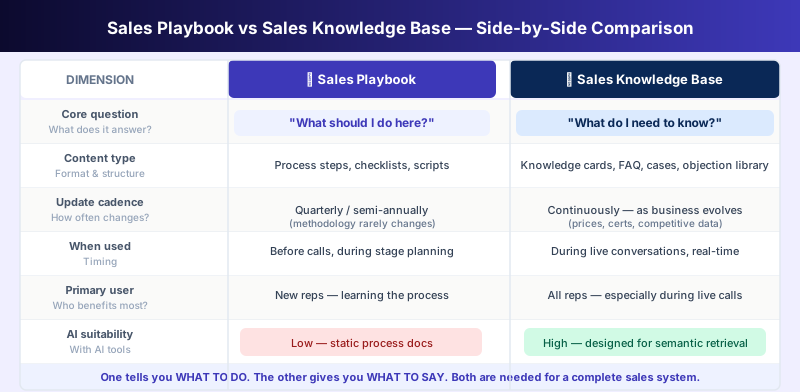
The Core Difference
| Dimension | Sales Playbook | Sales Knowledge Base |
|---|---|---|
| Core question | What should I do here? | What do I need to know? |
| Content format | Process diagrams, checklists, script frameworks | Knowledge cards, FAQ, cases, objection scripts |
| Update cadence | Updated with methodology changes — quarterly or semi-annually | Updated continuously as business events happen |
| When used | Before execution, during stage planning | During a live customer interaction or prep |
| Primary beneficiary | New reps who need a process framework | All reps who need real-time knowledge access |
| AI retrieval suitability | Low (usually static documents) | High (designed for semantic search) |
Common Mistakes
Mistake 1: Assuming a playbook covers what a knowledge base covers.
A playbook can tell a rep "this is a competitive objection, and in the evaluation stage you should focus on differentiation." But it cannot tell the rep what to specifically say when the customer asks how your product compares to a named competitor on a specific technical dimension. That requires a knowledge base.
Mistake 2: Building a knowledge base that is really a playbook in disguise.
Product manuals, training decks, and competitive comparison tables dumped into a "knowledge base" and organized by sales stage. The result is something that functions as neither — not a process guide, not a searchable knowledge layer.
Mistake 3: Treating the playbook as more important.
Before AI-assisted retrieval, knowledge bases suffered from a practical problem: reps could not find what they needed fast enough to use it in a live conversation. So playbooks got the attention because they were actionable upfront. AI changes this. Real-time semantic retrieval from a well-built knowledge base is now fast enough to be useful in an active conversation — which changes the relative value of each tool.
How the Two Work Together After AI
AI does not change what a playbook is or what a knowledge base is. But it significantly amplifies the utility of the knowledge base in live sales situations.
Before AI: A knowledge base was primarily used for offline study — onboarding, preparation before a big meeting. Too slow for real-time use.
After AI: A well-structured knowledge base can be queried in seconds and return a relevant product fact, objection response, or case reference during an active conversation.
Here is a concrete example:
A rep is in a customer conversation. The buyer raises a competitor's lower price and implies the quality should be similar.
Old workflow: The rep responds from memory or follows up with details after the call.
New workflow: The rep queries the knowledge base and retrieves the relevant competitive battlecard and a matching customer success story — during the call.
In this scenario, the playbook tells the rep "this is a competitive objection in the evaluation stage — reinforce differentiation." That is methodology. The knowledge base provides the ammunition: the specific competitor comparison, the differentiating facts, the customer proof point.
One tells you what to do. The other gives you what to say. Both are needed.
Which Should You Build First?
The answer depends on your team's most acute problem.
Build the playbook first if:
- Sales execution is inconsistent — different reps handle the same stage in very different ways
- New reps don't know the process well enough to push deals forward
- Pipeline forecasting is unreliable because stage definitions are unclear
Build the knowledge base first if:
- Reps frequently give inaccurate answers to customer questions and need to follow up
- New rep ramp time is slow primarily because product and competitive knowledge is hard to access
- Key knowledge lives inside a few experienced reps and the team has a dependency risk
Build both in parallel if:
- You are introducing AI tools and want them to operate with real sales context
- Your team has more than five people and knowledge silos are already forming
Summary
A sales playbook and a sales knowledge base are complementary, not substitutes.
- The playbook provides the process framework and execution logic
- The knowledge base provides the content foundation and real-time recall capability
AI has increased the value of the knowledge base by making real-time retrieval practical in live conversations. But it also raises the bar: AI-retrieved knowledge must be accurate, sourced, and current — otherwise AI-generated suggestions create trust problems rather than solving them.
KnowSales is designed specifically around this principle: sales knowledge that can be accurately retrieved and cited by AI in the moment it matters, rather than sitting in a folder waiting to be discovered.