Sales Knowledge Compound Interest: Every Customer Conversation as a Permanent Team Asset
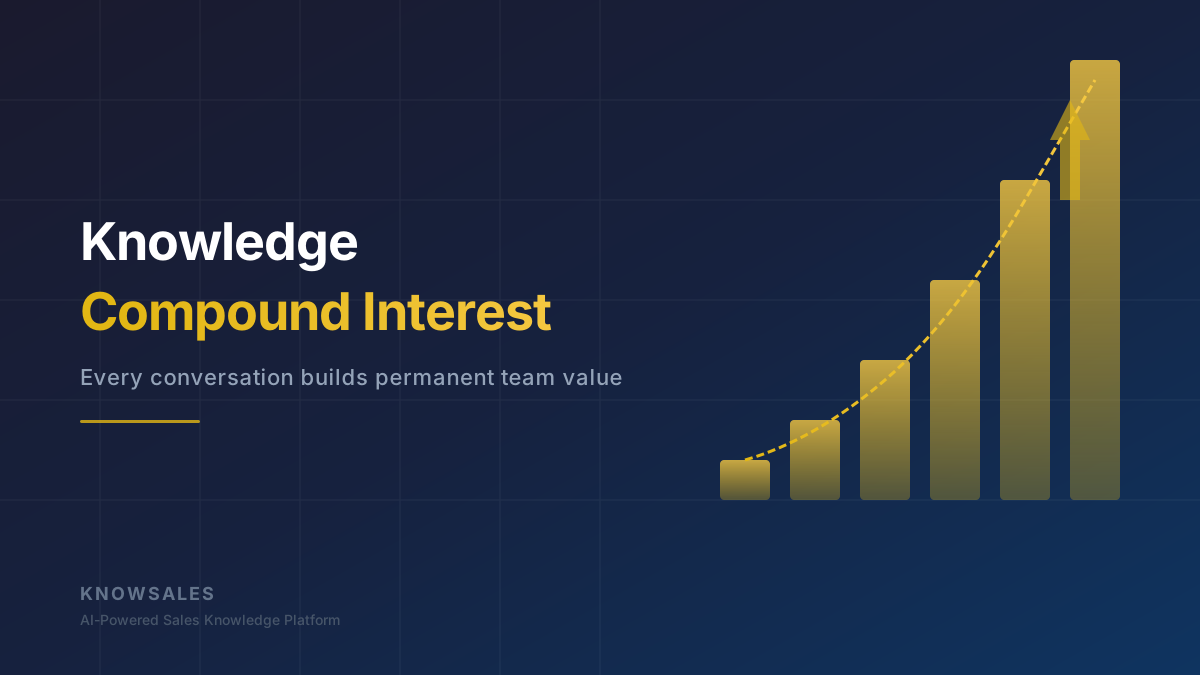
Your top salespeople carry irreplaceable knowledge in their heads. When they leave, it's gone. AI-powered knowledge compound interest turns every successful conversation into a compounding team advantage.
The Problem That Keeps Sales Leaders Up at Night
A top-performing rep just handed in a resignation.
This rep has been with the company three years. In that time, they built up hundreds of customer interactions, dozens of battle-tested objection responses, and an intuitive grasp of exactly how to position against every competitor. They know the pricing psychology, the decision-making triggers, and the specific phrases that close deals in your industry.
Tomorrow, all of that walks out the door with them.
This isn't a rare event — it's the defining challenge of sales leadership. The average tenure of a B2B salesperson is 18-24 months. Training a new rep to full productivity takes 6-12 months. By the time you've closed the gap they left, you're already facing the next departure.
The tragedy isn't that the knowledge is gone. It's that the knowledge never needed to be lost in the first place.
The Principle Warren Buffett Actually Lives By
Buffett's most famous quote is about compound interest:
"Compound interest is the eighth wonder of the world. He who understands it, earns it; he who doesn't, pays it."
We apply this principle to money. But Buffett himself has said knowledge compound interest is even more powerful — he spends 80% of his time reading because knowledge compounds. Each new insight connects to what you already know, creating understanding that becomes exponentially more valuable over time.
Sales teams follow the same logic. But most companies operate with a fundamentally linear knowledge model:
- Linear accumulation: Each rep learns independently, building personal expertise with no systematic sharing
- Periodic reset: When people leave, individual knowledge vanishes and teams start over
- Fragmented storage: Winning scripts live in chat threads, personal notebooks, and memory — unsearchable and unreplicable
Under this model, teams spend enormous resources reinventing the wheel, quarter after quarter.
What Andrej Karpathy's "File-Back Loop" Teaches Sales Teams
Andrej Karpathy — former head of AI at Tesla, OpenAI co-founder — proposed a concept in 2025 that's reshaping how we think about AI-native systems: the File-Back Loop.
The idea is deceptively simple:
When an AI agent executes a task, it doesn't start from scratch. It reads context from a persistent file (knowledge store). After completing the task, new insights are automatically written back to that file, ready for the next invocation.
This mirrors biological long-term memory: each successful neural connection deepens the synaptic pathway, making the next recall faster and more accurate.
Map this onto a sales team:
| AI Agent Pattern | Sales Team Pattern |
|---|---|
| Read context from knowledge store | Pull from product knowledge, past cases |
| Execute task (dialogue / decision) | Execute sales conversation (objection handling, recommendation) |
| Write new insights back to store | Capture successful scripts, case outcomes |
| Next invocation is smarter | Team handles similar situations better next time |
This is the mechanical foundation of sales knowledge compound interest.
Why Traditional Sales Knowledge Management Fails
Most companies have tried knowledge management. Most have been disappointed. Here's why:
1. Knowledge Is Designed for Storage, Not Use
SharePoint, Confluence, Notion — these tools were designed around "how do we store information?", not "how do we surface the right information at the right moment?"
A salesperson on a live call doesn't have time to search a 50-page product manual. What they need is: when the customer says "your price is too high," give me the three most effective responses immediately.
2. Knowledge Capture Requires Human Initiative — and Humans Are Inconsistent
"Remember to fill in the debrief form after every call." Every sales manager has said this. Every salesperson has dreaded it.
The friction of active capture is too high. Most insights evaporate when the project closes and the next deal begins.
3. Knowledge Exists in Silos, Preventing Emergent Value
Even when knowledge is captured, isolated fragments don't create leverage.
A single "price objection" success story, connected to competitive comparison data, ROI calculators, and customer decision-making patterns, becomes exponentially more valuable. Traditional tools can't create these connections automatically.
The Four Flywheels of Sales Knowledge Compound Interest
A functioning knowledge compound interest system requires four interlocking flywheels:
Flywheel 1: Zero-Friction Capture
The cost of capture must approach zero.
The ideal: after a customer call, AI automatically extracts key information (objection type, response used, outcome), generates a structured knowledge card, and sends it to the rep for one-tap confirmation. No forms. No manual work. Capture as a natural byproduct of the workflow.
The principle: don't rely on human initiative. Make capture the path of least resistance.
Flywheel 2: Semantic Retrieval, Not Keyword Search
Knowledge only creates value when retrieved at the right moment.
The problem with keyword search: salespeople don't know the right words to search. They know "customer thinks we're too expensive." The knowledge base contains "price-sensitive customer objection strategy." Same meaning, different vocabulary — traditional search fails.
Semantic vector search solves this: find by meaning, not by exact words.
Flywheel 3: Knowledge Connection Networks
Knowledge must not exist as islands.
When a "price objection" script is retrieved, the system should automatically surface:
- Relevant competitive comparison data
- Historical cases where this script succeeded
- Customer profiles (industry, size) where it's most effective
- Supporting ROI calculation materials
The richer the connections, the higher the value of every piece of knowledge.
Flywheel 4: Usage Feedback Loops
Whether and how effectively knowledge is used must flow back into the system.
If a script is used 50 times with a close rate 40% above average, it should be labeled "gold" and surfaced preferentially in future recommendations.
Usage is training. Outcomes are rewards.
How KnowSales Implements This: Product Island + Script Island
These four flywheels take concrete form in KnowSales through a two-layer architecture: the Product Island (structured knowledge foundation) and the Script Island (situational knowledge application layer).
Product Island stores factual knowledge:
- Product features, specifications, pricing logic
- Competitive comparisons (quantifiable dimensions)
- Customer case studies (industry, scale, pain points, outcomes)
- Standard response frameworks for common objections
Script Island stores situational knowledge:
- Conversation paths for different customer types
- Progression strategies for different deal stages
- Validated gold scripts (with usage data)
- Lessons from failed attempts
Both layers connect through a semantic vector network. When a salesperson is in a customer conversation, AI retrieves across both layers in real time, providing contextual, data-backed suggestions — not generic product descriptions.
Measured Results: What Knowledge Compound Interest Looks Like in Practice
This isn't theoretical. Here's what we've seen with early adopters:
SaaS Enterprise Team (12 reps):
- Time for new reps to reach average performance: reduced from 8 months to 3.5 months
- Objection handling success rate: +34%
- Time to customize customer proposals: reduced from 4 hours to 45 minutes
Industrial Manufacturing Sales Team (25 reps):
- Accuracy on technical specification questions: from 62% to 91%
- Follow-up rate (resolving questions in one interaction): -41%
- Manager time spent on field coaching: saved 6.5 hours per week
Knowledge compound interest doesn't produce results in one quarter. But it's the only mechanism that makes organizational capability grow exponentially over time.
Your Minimum Viable Path to Knowledge Compound Interest
If you want to start tomorrow, here's the smallest effective path:
- Choose one high-frequency scenario: Don't try to capture everything. Start with "price objections" or "competitive comparisons" — specific, high-impact, high-frequency
- Build seed knowledge from your best performers: Collect scripts from your top 3-5 reps, structure and load them
- Clear the retrieval path: Ensure every rep can find and contribute knowledge naturally before and after conversations
- Track usage data: Record which knowledge gets used and what outcomes follow, creating the feedback loop
The starting point isn't "get all knowledge organized." It's get the first valuable piece of knowledge flowing.
Sales knowledge management has never been an IT project. It's competitive strategy.
Every insight you capture today becomes a strategic advantage the next time your team faces the same customer situation.
Start compounding. The best time was yesterday. The second best time is now.