How to Measure Sales Knowledge Base ROI: 6 Metrics That Actually Matter
You built the knowledge base — but how do you know it's working? These 6 measurable metrics give sales managers a data-backed way to prove the ROI of their knowledge investment, from new rep ramp time to AI answer accuracy.
Why "Feels Useful" Is Not Enough
A sales knowledge base is one of the hardest sales enablement investments to quantify. Unlike a CRM where you can track pipeline volume, or an ad campaign where you can measure click-through rates, a knowledge base delivers value by reducing negatives: fewer wrong answers, fewer delays waiting for internal confirmation, fewer mistakes by new reps.
Because the value is mostly invisible, many teams build a knowledge base, ship it, and never track whether it is actually working. When a manager asks "is it worth it?", the honest answer is "we think so, but we can't prove it."
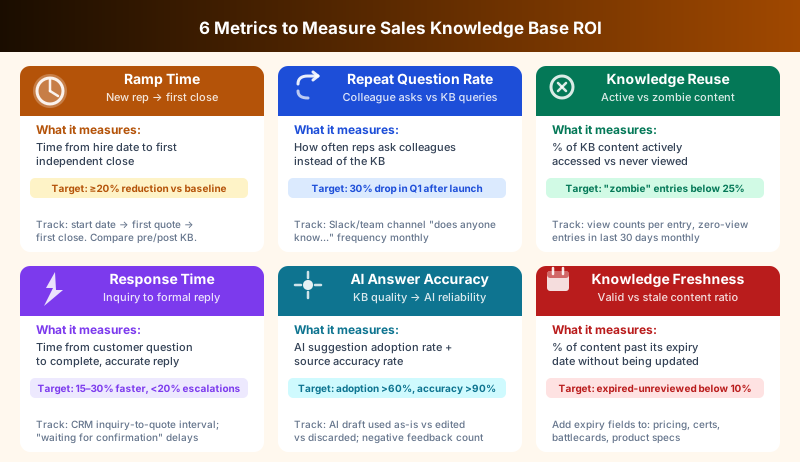
These six metrics convert "thinks so" into something you can show in a quarterly report.
Metric 1: New Rep Ramp Time
What it measures: Time from a new sales hire's start date to their first independent close.
Why it matters: This is the most direct impact metric for a knowledge base. The core promise is that new reps should be able to find product knowledge, objection responses, and process guidance without waiting for a senior rep to walk them through it.
How to track it:
Record three dates for each new hire:
- Start date
- Date of their first independent customer presentation or quote
- Date of their first close
Establish a baseline from before the knowledge base was built. Compare against new hires who joined after launch.
Calibration method: Record the historical median for equivalent roles, then calculate changes in manager coaching time and earlier independent work. Do not treat one percentage as an industry standard.
Metric 2: Repeat Question Rate
What it measures: How often reps solve a problem by asking a colleague instead of checking the knowledge base.
Why it matters: If the knowledge base has the answer but reps are still asking people, the content is failing — it's either hard to find, too complex, or not accurate enough to trust. A declining repeat question rate signals that the knowledge base is genuinely absorbing these requests.
How to track it:
Two practical approaches:
- Monitor team Slack / WeChat channels for question-asking patterns. Count messages starting with "does anyone know…" or "who has the template for…" on a monthly basis.
- Quarterly pulse survey: "In the past month, how many times did you search the knowledge base, not find what you needed, and ask a colleague instead?" (1–10 scale)
Calibration method: Record colleague-directed questions for one complete pre-launch period, then set the next period's target from that baseline. Distinguish a real reduction from questions merely moving to another channel.
Metric 3: Knowledge Reuse Rate
What it measures: The proportion of knowledge base content that is actively being accessed, and the distribution of high-use versus dead content.
Why it matters: This tells you whether the content matches what reps actually need. If 80% of access concentrates on 20% of entries, the rest is either unfindable or irrelevant.
How to track it:
- Track view counts per knowledge entry. For knowledge bases with search, track query-to-result access rates.
- Monthly: calculate the percentage of "zombie entries" — content with zero views in the past 30 days.
- Track how often specific objection scripts or product facts are cited in actual sales conversations (via sales self-reporting or AI conversation logs if available).
Calibration method: Define the inactivity window from the team's real usage frequency. Treat any relationship between content use and close rate as a correlation signal, not proof of causation.
Metric 4: Customer Response Time
What it measures: Average time from receiving a customer question to delivering a complete, accurate response.
Why it matters: In B2B and foreign trade sales, response speed affects close rates directly. If a rep has to wait for internal confirmation before replying, opportunities narrow. A knowledge base that gives reps the confidence to respond without escalating every question should show up in response time data.
How to track it:
- In your CRM or email system, track the interval between "inquiry received" and "formal quote or response sent."
- Compare before and after knowledge base launch.
- Track "waiting for internal confirmation" delays separately — if this specific delay type decreases, the knowledge base is working.
Calibration method: Build a pre-launch baseline from matched customer questions, then compare total response time and time spent waiting for internal confirmation without assuming a fixed reduction.
Metric 5: AI Answer Accuracy Rate
What it measures: When reps use AI tools that draw from the knowledge base, how accurate and adopted are the generated responses.
Why it matters: In AI-assisted workflows, knowledge base quality directly determines whether the AI's suggestions are usable. If AI frequently gives wrong answers, reps stop trusting it. If AI answers are accurate, adoption compounds. This metric tells you whether your knowledge base is "AI-ready."
How to track it:
- Track adoption rate of AI-generated email drafts and response suggestions: used as-is, significantly edited, or discarded.
- Monthly: sample-check 20–30 AI-cited knowledge sources for accuracy and timeliness.
- Count "AI gave incorrect information" feedback events through negative feedback buttons or rep reports.
Calibration method: Define accepted as-is, lightly edited, heavily edited, and discarded, then set targets by risk. For high-risk product and contract information, source accuracy should take priority.
Metric 6: Knowledge Freshness Rate
What it measures: The proportion of knowledge base content that is within its valid timeframe.
Why it matters: Stale knowledge is more dangerous than no knowledge. A rep who cites an outdated price, an expired certification, or a competitor comparison that is six months old damages customer trust directly. A knowledge base's value is not just in how much it contains but in how reliably accurate it is.
How to track it:
- Add an "expiration date" or "valid until" field to time-sensitive content categories: pricing rules, competitive battlecards, certification documents, product specifications.
- Monthly: calculate the percentage of entries that have passed their expiration date without being reviewed.
- Track the number of "error from stale knowledge" incidents if you can collect them.
Calibration method: Prioritize an owner and review date for pricing, certification, specification, and competitive material. The acceptable threshold should follow business risk rather than a universal percentage.
Translating Metrics into an ROI Report
Managers typically need to convert knowledge base investment into concrete business value. A simple translation framework:
Time savings:
- Ramp time reduction × average monthly rep output = incremental revenue from earlier productive capacity
- Repeat questions reduced × average manager response time = manager hours recovered per quarter
Quality improvements:
- Faster customer response time → improved inquiry-to-quote conversion rate × average deal value
- Higher AI answer accuracy → fewer rework events × time cost per rework
Risk reduction:
- Probability reduction of losing a deal due to outdated information × average deal value
- Reduced knowledge loss cost when experienced reps leave
A Minimum Viable Measurement Plan
You do not need to track all six metrics from day one. A sensible sequence:
Month 1: Track only repeat question rate. It is the easiest to collect and the most immediate signal.
Quarter 1: Add new rep ramp time comparison.
Quarter 2: Add knowledge reuse rate and freshness rate.
After AI tool introduction: Add AI answer accuracy rate.
Each quarter, produce a one-page knowledge base health report: core metric trends, most-used and least-used content, entries added and retired that quarter.
Summary
A sales knowledge base ROI needs to be actively tracked to go from "we think it's working" to something you can present to leadership.
Six metrics to track: ramp time, repeat question rate, knowledge reuse rate, customer response time, AI answer accuracy, and knowledge freshness.
The prerequisite for all of them: quality before volume. One hundred accurate, searchable, sourced knowledge entries deliver more ROI than one thousand scattered, outdated documents.
KnowSales is built with this principle in mind: every knowledge entry has a source, a context, and a usage trail, so the data for ROI measurement exists in the system rather than having to be reconstructed.