Foreign Trade Sales Objections: How to Handle Common Customer Pushback in WhatsApp and Email
The 7 most common objections foreign trade buyers raise — from price and MOQ to payment terms and factory audits — with real WhatsApp and email response examples your team can adapt and reuse.
Why Foreign Trade Objections Are Different
Foreign trade sales objections have three characteristics that make them harder to handle than standard domestic B2B objections.
The cycle is long. From the first inquiry to a signed order, the process can take anywhere from three months to eighteen months. The same buyer will raise very different objections depending on where they are in the cycle — early-stage objections are exploratory, mid-stage objections are about benchmarking price, and late-stage objections are often about reducing risk before committing.
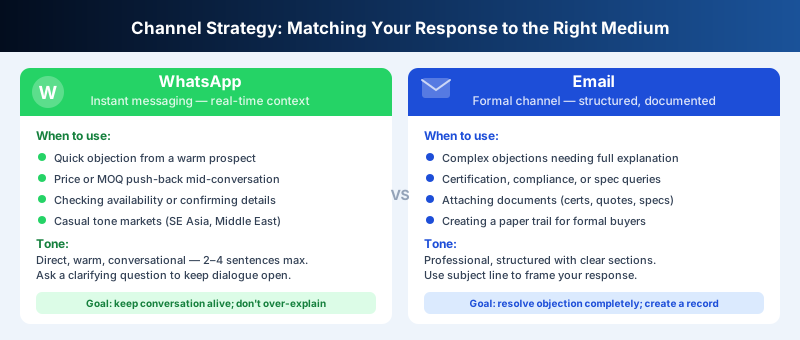
The channels are fragmented. A single buyer may contact you on WhatsApp, send a formal inquiry by email, and request a video call to confirm specifications. Each channel requires a different communication style, and your response needs to match the format.
Trust costs more. Overseas buyers cannot easily visit your factory. Their decision is based almost entirely on documents, photos, certifications, and what other buyers have said. A single credibility gap can end the conversation.
Below are the 7 most common objections in foreign trade sales, with response examples for both WhatsApp and email.
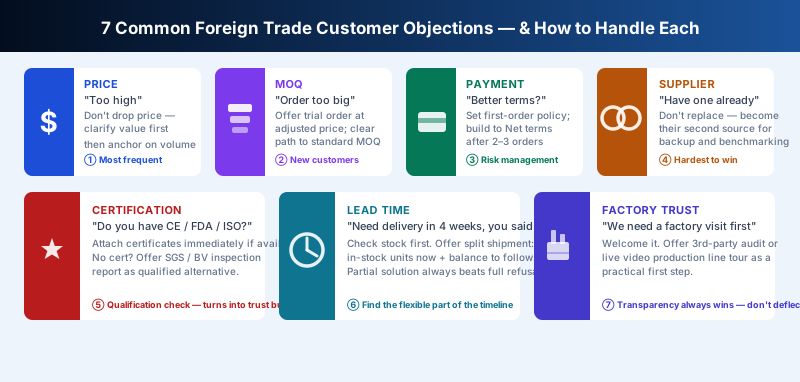
1. Price Objections — "Your price is too high"
This is the most frequent objection in export sales, but the actual percentage of deals lost on price alone is much lower than it feels. In most cases, the buyer is testing your flexibility or has not yet absorbed the full value of what you are quoting.
WhatsApp response:
"Thanks for the feedback. May I ask what quantity you're looking at? Our pricing varies significantly by MOQ, and for orders above [X] units we have a more competitive rate. Also, our quote includes [specific value — e.g., third-party inspection, sea freight to your port, 12-month warranty]. Happy to break this down if it helps."
Email response framework:
Subject: Re: Price Feedback — Let me show you the full picture
Acknowledge the feedback first. Then break down the price components (materials, process, certification, service). Present your quantity tiers. Close with a total-cost comparison if you have one.
The goal is not to defend the number — it is to reframe what the number covers.
2. MOQ Objections — "Your MOQ is too high"
This is the most distinctly foreign-trade objection. New buyers almost always want to start with a smaller order than your standard minimum.
WhatsApp response:
"Totally understand — most of our new customers start with a trial order. We can do [lower MOQ] for the first order at a slightly adjusted unit price, so both sides can test the fit. Once the product works well in your market, we can move to the standard MOQ for better pricing. Does that work?"
Email response framework:
Subject: Trial Order Option for [Product Name]
State the trial order conditions clearly: quantity, adjusted unit price, lead time, and the path to standard MOQ pricing. Make it easy for the buyer to say yes to a small starting step.
3. Payment Terms Objections — "We need better payment terms"
"We can only do Net 60." / "Can you accept L/C?" / "We need 30% deposit, 70% after delivery."
Payment terms touch on real financial risk, so this is not an objection you can brush aside. But a flat refusal ends deals unnecessarily.
Response strategy:
- For new buyers, state your standard terms clearly and explain why they are standard (30% T/T deposit, 70% before shipment is common and protects both parties on a first transaction).
- Offer a path: once two or three orders are completed, you are open to discussing more flexible arrangements.
- If you accept L/C, specify the exact conditions upfront (sight L/C, within 60 days, etc.) to avoid disputes later.
WhatsApp response:
"For new partners, our standard is 30% T/T deposit with 70% before shipment — this protects both sides on the first order. After we've completed a couple of orders together, we're open to discussing other arrangements. This is how we work with most of our customers in [region]."
4. Existing Supplier Objections — "We already have a stable supplier"
"We've been working with our current supplier for five years. Why would we switch?"
This is the hardest objection because the buyer genuinely has no obvious pain. The wrong move is to try to convince them to switch. The right move is to position yourself as a second source.
Response:
"That makes complete sense — loyalty to a reliable supplier is good practice. We're not asking you to switch. What many buyers do is add a second source for price benchmarking, or as backup during peak seasons or supply disruptions. A small trial order gives you a reference point and a backup option, with no pressure to change anything with your current supplier."
5. Certification and Quality Objections — "Do you have CE / FDA / ISO?"
"Our market requires CE certification. Can you provide it?"
This is not really an objection — it is a qualification check. Handle it promptly and completely.
If you have the certification: Send the document immediately. Include the validity date and the specific models or product categories it covers.
If you do not: Be honest. Offer alternatives — a third-party test report from SGS, BV, or Intertek; help with the buyer's own certification application; or clarification on which markets the product is already approved for.
Never guess. One false certification claim can end the relationship and create legal liability.
Email example:
"Please find attached our CE certificate for [Product Name], valid until [date], covering [specific models]. If you need additional documentation for customs clearance or local compliance, let me know and I will coordinate with our QA team."
6. Lead Time Objections — "Your lead time is too long"
"We need delivery in four weeks, but you said eight weeks. Can you do it faster?"
First, check whether you have stock. If it is a standard product, partial stock shipments are often possible. If there is no stock, break down the lead time into components (production, QC, sea freight) and find where you have flexibility.
WhatsApp response:
"Let me check our current production schedule. We have [X] units in stock that could ship within two weeks. For the remaining quantity, we can prioritize your order and target delivery by [date]. Would a split shipment work — stock items first, then the rest to follow?"
Partial solutions are almost always better than a flat no.
7. Trust Objections — "We need to visit your factory first"
"Before we place any order, our team needs to conduct a factory audit."
This is standard practice for large buyers. Do not avoid it — embrace it.
Response:
"We welcome factory visits and audits — it is the best way to build confidence on both sides. We also work with [SGS / BV / Bureau Veritas] if you would like a third-party audit first. If an in-person visit is not possible right now, we can arrange a live video walkthrough of the production line. Which option works better for your timeline?"
Turn These Responses into Team Knowledge
The seven objection types above all follow a pattern: each one requires a combination of response logic, supporting documentation, and situational judgment. The problem for most export sales teams is that this knowledge stays inside the heads of experienced reps or buried in old email threads.
When a new rep faces a buyer who says "your MOQ is too high," they should not have to guess. They should be able to pull up the approved trial order policy, the pricing tiers, and a recent example of how this exact situation was resolved.
That is what a sales knowledge base does for foreign trade teams: it connects the objection to the internal context — pricing rules, certification documents, past successful responses, customer segment notes — so the rep can give a confident, accurate answer instead of an improvised one.
KnowSales is built specifically for this workflow: capture the objection handling logic, link it to the product knowledge that backs it up, and make it searchable for the whole team.
Summary
Handling foreign trade objections well requires three things:
- Read what is behind the objection — a price objection might be a test; a supplier loyalty objection might be an opening for a second-source conversation
- Have the supporting material ready — certifications, delivery breakdowns, pricing tiers, case studies
- Match the channel — WhatsApp responses need to be short and direct; email responses need structure and attachments
- Capture what works — every well-handled objection is worth recording so the next rep does not start from zero